On one side are the grand narratives of top-level organizational designers; on the other, frontline managers who don't even know how to use the "Expert Mode." The larger the enterprise, the more fragmented it becomes. Does organizational development in the AI era really need grand narratives?
Putting AI Strategy into Practice: Return First to the Fundamental Questions About "People"
In recent years, while accompanying companies through AI strategy implementation, one feeling has become increasingly clear: senior leaders tend to talk about future direction, grand transformation, and lofty terms like "productive forces and production relations," "Token economics," "liquid organization," and "agent organization." Yet when it comes to actual implementation, the easiest problems to encounter are at the most basic level of "usage." Senior leaders themselves barely use AI; managers at every level don't even use Doubao's "Expert Mode" to solve problems; and internal AI applications often go largely unused... In the process of implementing AI strategy, it's worth stepping back from these grand-narrative discussions and returning to the most basic organizational unit—"people"—and the most basic question—"usage"—otherwise even the most perfect top-level design risks becoming a castle in the air. Abstract propositions like "productive forces" and "production relations," once broken down into a company's daily operations, are really very simple questions: How can ordinary employees use AI to do their work better? How can frontline managers adapt to new ways of collaboration? How can small teams redivide labor around AI? Solve these questions well, and the value of technology will naturally be unlocked. Conversely, no matter how grand the narrative, it is hard to truly land.
1. Talk About Human Growth First, Then Productivity Upgrades
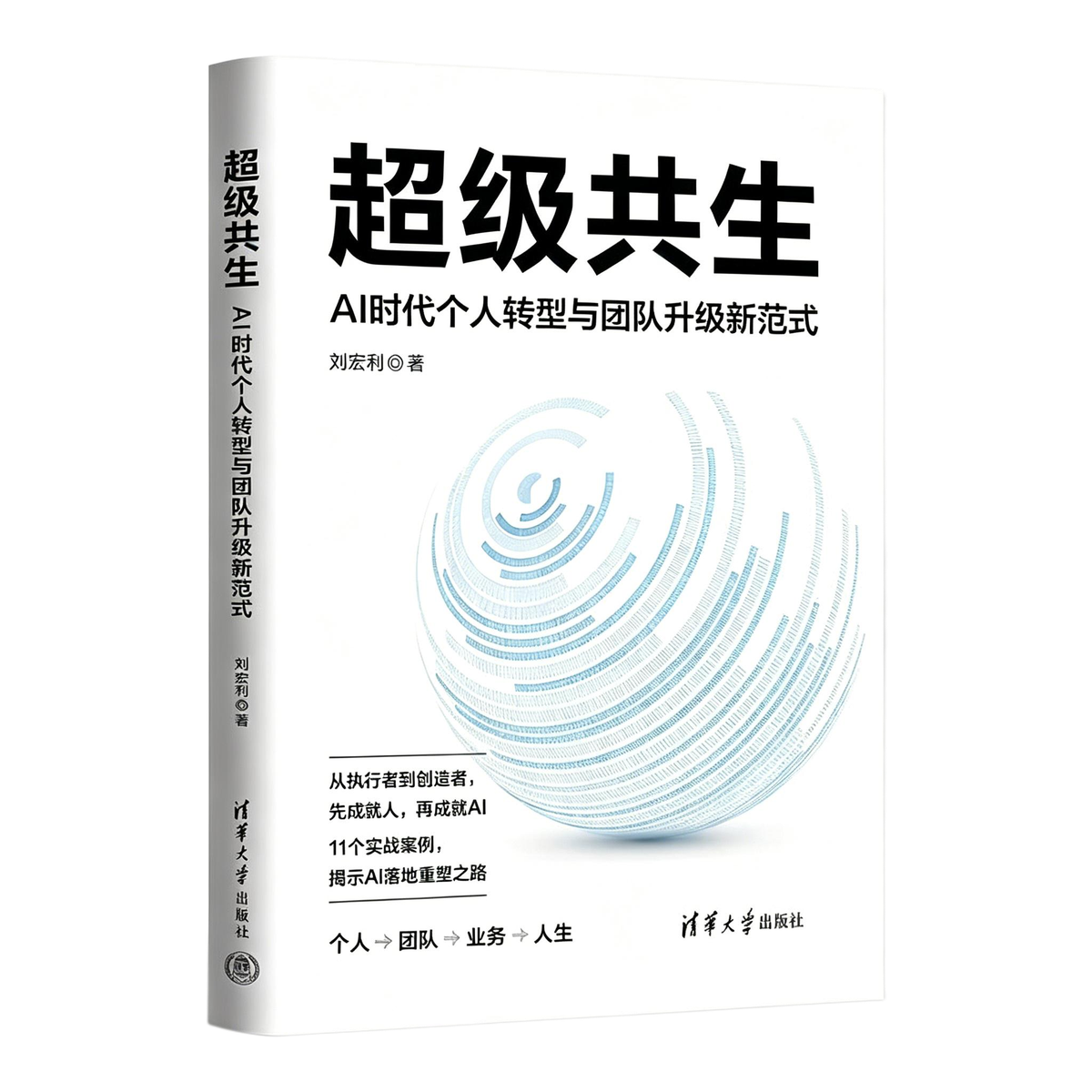
A common first mistake many companies make when pushing AI transformation is treating AI as a "tool that replaces people." This framing puts AI at odds with people from the very start. People instinctively hide their experience and slow their learning, afraid of being replaced by technology. This is also why many companies spend millions on the most advanced AI systems, only to end up with expensive ornaments that nobody wants to use. I have always believed that The essence of productivity upgrades, is never about how many people AI replaces, but about how much each person's capabilities are amplified through AI. What AI can do will always be repetitive, mechanical execution work; what people truly cannot be replaced for is the ability to judge "what is worth doing." So the first step in AI implementation is not to roll out systems or build some liquid organization, but to help "people" build a sense of security. AI is here to free "people" from tedious work, not to take "people's" jobs. Account managers no longer need to spend hours organizing client data and writing reports; the saved energy can go into genuinely valuable, in-depth client communication. Next comes scenario-based capability building. Avoid generic, ceremonial training for all staff. Instead, for the specific work of different roles, teach people how to use AI to solve the problems they face every day—teach operations how to use AI for data analysis, teach customer service how to use AI to respond to client issues quickly, teach product how to use AI for user research. Learn it and you can use it; use it and you see results. Finally, establish positive incentive mechanisms. Don't assess "whether AI was used"; assess "what value AI created." Whoever can use AI to improve their work efficiency and optimize their output earns the corresponding rewards and more growth opportunities. When people see that AI can tangibly help them become better, they will naturally take the initiative to learn and use it. The logic is simple: no one rejects a tool that makes them better, and people must first embrace Harmonized Intelligence with AI.
2. Talk About the Manager's Role Evolution First, Then Production-Relation Reform
In the AI era, the people facing the biggest challenge are actually middle managers. Their past core work—assigning tasks, monitoring progress, reviewing results, passing information up and down—much of it can now be assisted or even replaced by AI. This role ambiguity easily makes managers anxious and can even turn them into resistance to AI transformation. I wrote in Harmonized Intelligence that the essence of production-relation reform was never redrawing the organizational chart, but the fundamental evolution of the manager's role. In the age of human–AI symbiosis, the manager is no longer the team's "controller," but the empowerer of the symbiotic entity". This role evolution can be divided into three directions. First, shift from "controlling the process" to "defining outcomes and providing context." Old management was "telling you how to do it"; modern management should be "telling you what goal we want to achieve, and why we're doing it." Hand the concrete execution to employees and AI; the manager's core value is to provide clear goals, ample background information, and the necessary resource support. Second, shift from "assessing individuals" to "cultivating team capability." The best manager is not the one who uses AI best themselves, but the one who gets the whole team to learn to use AI. The manager's assessment metrics should include dimensions like "team AI-capability growth" and "talent development," encouraging them to share their experience with subordinates and help the team grow together. Third, shift from "mouthpiece" to "value filter". The manager must become a buffer between the team and the company, blocking out unnecessary meetings, cumbersome processes, and unreasonable demands, creating an environment where the team can focus on creating value. This point is especially important in the early stages of AI transformation.
3. Talk About Small-Unit Collaboration Evolution First, Then Organizational Restructuring
Many companies are used to driving change top-down: at the first sign of AI transformation, they set up a dedicated AI department and require all business units to cooperate. But the reality is that AI implementation tends to grow bottom-up, and the most effective innovations always happen in frontline small teams. Personally, I have never favored that kind of "grand-narrative" organizational restructuring. Organizational evolution should be a bottom-up evolutionary process, not a top-down design process—not about drawing a perfect organizational chart first, but about encouraging the front line to form flexible, AI-collaborative small units first. Originally, teams were mostly divided by function—marketing, product, engineering—each managing its own slice. Now, around concrete business goals, cross-functional small teams can be formed: team members who understand the business, who can use AI to create content, who can use AI to analyze data—everyone collaborates with AI, rapidly experimenting and iterating. The benefits of this small-unit model are obvious: low trial-and-error cost, so even failure won't affect the whole company; high flexibility, enabling quick response to market changes; and replicable success, so once a model works, it can be rolled out across the company fast. When many such small units take root throughout the company, the natural adjustment of the organizational structure follows naturally.
True AI transformation is a quiet evolution
Finally, what I want to say is that AI's change to organizations is not a loud revolution, but a quiet evolution. It won't upend every industry overnight; instead, it will slowly seep into every role, every process, every collaboration. As a business leader, I'd suggest not rushing after those grand, disruptive goals. Take a breath and start with the small things around you: help your employees learn to use AI to boost work efficiency, help your managers adapt to new roles, help your teams build more efficient ways to collaborate. When every employee can work fluently alongside AI, every manager knows how to lead a team in the AI era, and every small team can create value efficiently, then the "productivity upgrades" and "organizational change" we once longed for will naturally unfold in this process. Many things, slow is actually faster.