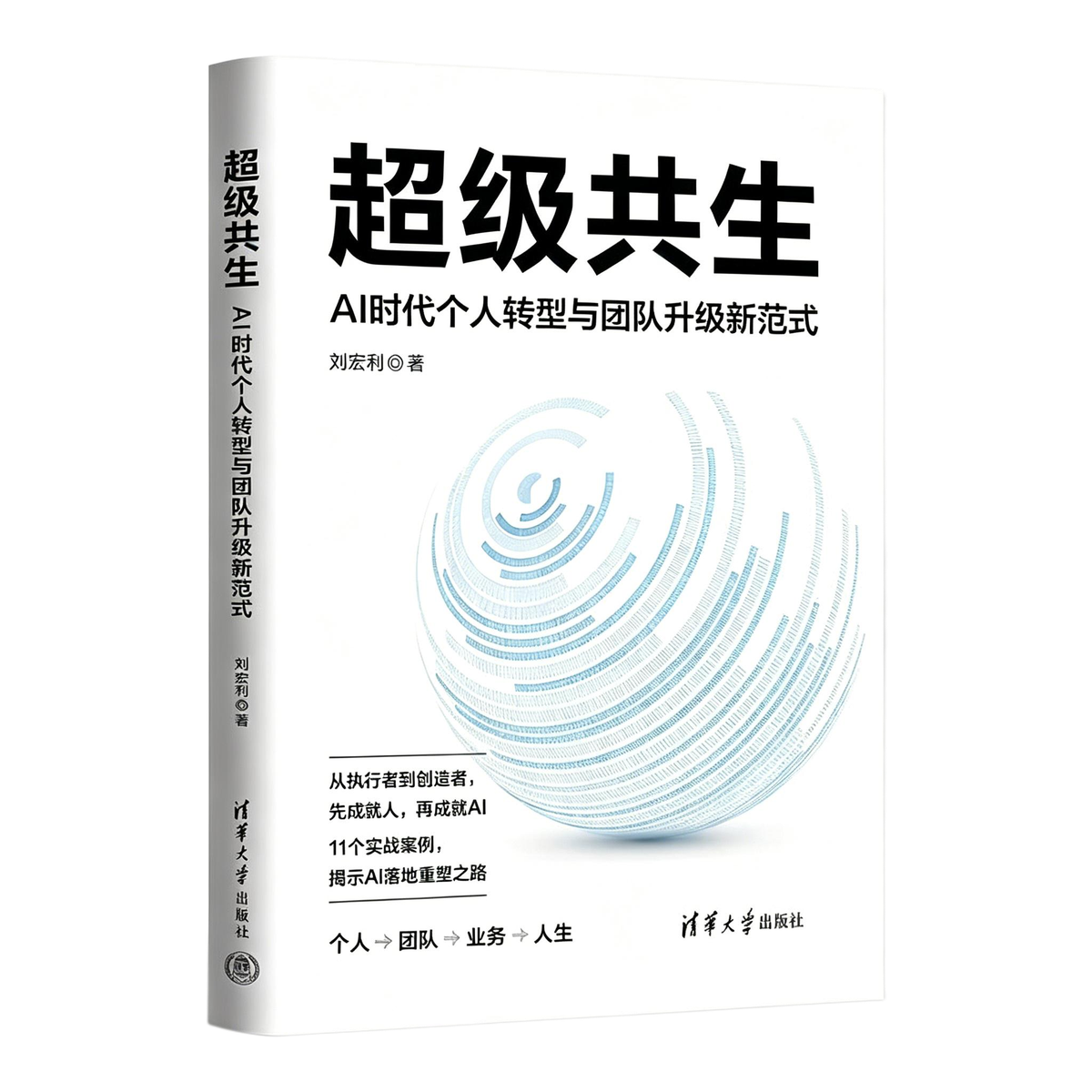
Harmonized Intelligence: Chapter-by-Chapter Q&A
With the AI era upon us, how should ordinary people respond?
Standing at the crossroads of the AI era, the first step is not to rush into learning tools, but to recalibrate how we relate to AI. The book summarizes common missteps into three kinds of "mismatch": applying the old logic of the industrial age to cope with AI, the new variable. To "use it right" essentially means restoring AI from a "trend to fight or chase" to a symbiotic variable that must be understood anew; only by figuring out which misconception we have fallen into can we decide where to go next. In a paradigm shift, direction matters more than speed, and posture matters more than tools.
The book tells of an HR director at a traditional manufacturing company who had worked in the industry for a full 15 years. When the company first introduced an AI recruiting system, her first reaction was: "Our line of work depends on judging people; what does AI know about that?" So she handed all system permissions to her subordinates and continued interviewing the old way. Half a year later, the capability-assessment model her subordinates built with AI was already approaching the level she had accumulated over many years in accuracy. She was not lacking in effort; she was simply using the experience she had honed for years to resist the turning of an entire era. The book points out that this is precisely the predicament of the "ostrich"-burying its head in the sand and ignoring the fact that AI's iteration is an exponential leap; by the time it wants to look up, there is often no time left to prepare. Similar to her are an e-commerce friend hoarding tools and a sales director with red-hot efficiency but declining revenue; the three seem different, but at their core they are all using old logic to respond to a new variable. The problem is not a lack of ability, but that they never took the first step of actually "using" it.
The ostrich's willful blindness, the squirrel's shallow dabbling, and the migratory bird's mental inertia are, at their core, all responses to the new variable of AI using old logic-a kind of "mismatch."
Can we stop treating AI merely as a tool and instead regard it as a partner?
The key first step to re-understanding AI is to break the instinctive association with a "super search engine." Our generation has been conditioned by search engines into fixed habits: type in keywords, get a definite answer. But the operating logic of large models has fundamentally changed-they no longer retrieve existing information, but generate entirely new content based on context. True AI is not a smarter office suite, but an intelligent companion that understands intent, participates in thinking, and co-creates; treating it as a tool uses only a ten-thousandth of its value.
The book illustrates this with a nationwide experiment during the 2026 Spring Festival. Alibaba's Qwen app invested 3 billion yuan in a "free milk tea" campaign: users only had to say to Qwen, "Order me a cup of milk tea," and the AI would automatically match nearby shops, select items, generate the order, and complete payment-all without the user switching between different apps. Within just 9 hours of launch, AI-generated orders surpassed 10 million, overwhelming milk-tea shops across the country with backlogs and leaving delivery riders in long queues, nearly collapsing the entire fulfillment chain. The book notes that this nationwide "Agentic AI stress test" let us experience at scale for the first time that AI is no longer just a "mouthpiece strategist" that only answers questions, but has truly grown "hands and feet" that can reach the real world and actually "get things done" for us. From merely answering to completing work on our behalf, agentic AI is redefining the boundary of human-AI collaboration-it was never a tool, but a symbiotic partner capable of taking on real tasks.
What we face is not a super search engine, nor a smarter office suite, but a digital companion that can think, create, and solve problems together with us.
Besides searching for information, can AI help me do something creative?
Moving beyond search-engine thinking means understanding that AI has leapt from "retrieval-based computing" to "generative computing." In the past, computers retrieved existing content from databases; AI, drawing on vast knowledge, understands intent and generates bespoke new answers. The origin of this leap was the perception revolution triggered by deep learning in 2012, which let machines "learn" to see the world on their own, and went on to evolve capabilities of generation, reasoning, and autonomous execution. Creativity is not a bug in AI, but the product of its probability-based generation of entirely new combinations-it can propose solutions no one ever imagined.
The book traces this evolution back to AlexNet, which burst onto the scene in 2012. This deep-learning model, developed by students under Geoffrey Hinton, defeated all traditional algorithms by an overwhelming margin in that year's ImageNet Large Scale Visual Recognition Challenge, with an error rate nearly 11 percentage points lower than the runner-up-a "gap-level lead" that shook the entire tech world. Before this, computer image recognition relied on manually designed rules and hand-labeled edges and colors, which was inefficient and limited in accuracy; AlexNet's core breakthrough was letting the computer "learn" to see the world on its own, ending the era of "manual labeling." The team also pioneered parallel computing across multiple GPUs, which both solved hardware limits and unexpectedly opened the new era of "compute-driven AI," from which Nvidia's GPU business took off. In his 2025 GTC keynote, Jensen Huang recalled that the moment he saw AlexNet, he decided to lead Nvidia into autonomous-driving R&D with full force-a breakthrough in a recognition model levered open the entire intelligent age, pushing AI from "recognition" to "generation," and opening the door to creativity.
It is no longer a simple information mover, but can, like a human, break down problems step by step, reason through logic, generate answers, and even propose new ideas and solutions we never imagined.
How can I make AI's answers more reliable, instead of it constantly making things up?
The key to improving AI output quality is not switching to a more powerful model, but closing three checkpoints: clear input instructions, dedicated algorithmic rules, and matching private-domain data. AI runs on the coordination of three elements-compute, algorithm, and data-where algorithm and data together determine output quality. Many people feel AI spouts correct nonsense; the root cause is that they only gave a need instruction without telling it our dedicated algorithms and business data, so it could only invoke generic logic-naturally "correct but useless." Only when all three checkpoints are closed does AI turn from a generic repeater into a dedicated partner that understands our business.
The book gives the example of a sales consultant writing a follow-up email. With only public-domain data, AI used generic sales knowledge from the internet to produce a polite, professional but utterly indistinguishable email: a greeting at the opening, product introduction in the middle, and "Looking forward to your reply" at the end-no different from what any ordinary salesperson would send. But once private-domain data was fed to AI-for instance, that this customer had complained about logistics delays last month, that he is the company's procurement director who cares most about "stable delivery" rather than "price discounts," and dislikes overly enthusiastic phrasing-the generated email changed: it opened with a sincere apology, the body was not a quote sheet but a concrete explanation of logistics-optimization measures, and the closing was a clear commitment on delivery progress. The book makes clear: same AI, same sales scenario-public-domain data only lets AI "avoid mistakes," while private-domain data lets AI "hit the key point," making the customer feel "you get me." This also shows that poor or hallucinatory AI output is not AI's fault, but that we failed to give it enough dedicated business material and judgment rules.
In fact, the poor quality of AI's output-all correct nonsense-is not AI's fault, but because we did not give it clear inputs, dedicated algorithms, and matching private-domain data.
How can I tell whether AI is making things up (hallucinating)?
To recognize AI hallucinations, we must first understand where they come from: AI does not retrieve facts, but predicts the "next word" based on probability, and in the process of associative reasoning and combination it naturally produces content that does not match reality-that is a hallucination. A hallucination is a double-edged sword-it is precisely the source of AI's creativity, not a fatal flaw. The key to mastering it is not to eliminate hallucinations, but to manage them by scenario: release them in creative exploration, constrain them in factual verification. One who manages hallucinations rather than fears them can move from user to collaborator. This very understanding is the starting point of the human-AI journey toward symbiosis.
The book divides hallucination management into two scenarios. In creative exploration-such as product innovation, content ideation, marketing strategy, and business-model design-we need to actively release AI's hallucinations, letting it help us break free from entrenched industry inertia and mental ruts, bringing entirely new perspectives, ideas, and possibilities; whereas in factual verification-such as data checking, compliance writing, financial analysis, and legal contract review-we must strictly constrain hallucinations, letting it output only on the basis of real data, compliance rules, and factual information, while manually verifying the results to avoid the risks of false information. The book emphasizes especially: many people give up using AI simply because it can confidently talk nonsense; that is "throwing away the baby with the bathwater." The right approach is to unleash it where imagination is needed and rein it in where certainty is required, calibrating the scale across different scenarios. The same AI: those who manage hallucinations use it as a spark, while those who cannot are led into pitfalls by it-the difference lies entirely in scenario judgment.
AI's hallucinations can help us break free from entrenched industry inertia and mental ruts, bringing us entirely new perspectives, new ideas, and new possibilities.
I'm always anxious about being replaced by AI-how do I break this anxiety?
To shed the anxiety of being replaced, we must first debunk a false assumption: treating AI as a competitor. This anxiety stems from trapping ourselves in the execution steps that AI can replace, and voluntarily giving up the most core, most irreplaceable competitiveness. In fact, AI is not a rival stealing our jobs, but a lever that amplifies our core value-it can replicate execution, yet cannot replace our understanding of the brand, our insight into users, or our judgment of the business. Our opponent was never AI, but whether we can keep growing.
The book gives two real and heartwarming examples. A fitter who had worked ten years at a traditional auto plant had his core skill-precision part polishing-fully replicated by an AI robotic arm; seemingly "robbed of his job," his core value did not disappear, but shifted toward continuous process optimization. A risk-control specialist who had worked eight years at a bank had her core work of manually reviewing loan documents taken over by AI; her core value also shifted toward optimizing risk models and deeply mining customers' credit worth. The book concludes that AI did not eliminate them, but liberated them from repetitive execution work, letting them focus on more valuable things. The same pattern appears in writing, data analysis, outbound communication, and coding: AI can replace actions, but not a person's hold on value, meaning, and relationships. The antidote to anxiety is to shift energy from "competing with AI on execution" to "using AI to amplify oneself." When the relationship changes from competition to symbiosis, the anxiety of being replaced naturally dissolves.
What AI amplifies is the core value we already possess-our cognitive boundaries, business understanding, and value judgment. It is we ourselves who determine how much leverage this lever can exert.
People keep talking about paradigm shift-what does that term actually mean?
A paradigm shift refers to a fundamental transformation that overturns the original system and rewrites the rules of an entire field. It never begins at the surface, but first shakes the most fundamental, taken-for-granted, never-questioned "assumption"; once the underlying assumption is overturned, the entire rule system built upon it collapses and is rebuilt. To understand a paradigm shift, the key is to grasp the "underlying assumption" as the source-only when it changes do the forms of the individual, the organization, and life get reconstructed layer by layer.
The book uses the most famous paradigm shift in scientific history to clarify this process. For over two thousand years, humans, relying on intuition, held that "the Earth is the center of the universe"; the ancient Greek astronomer Ptolemy turned it into the precise mathematical system of the "geocentric model," which could even predict planetary positions. But some planets occasionally "retrograde," which the geocentric model could not explain, so astronomers could only keep patching it: planets circled small epicycles, which in turn circled large deferents, making the system ever more bloated. Until 1543, when Copernicus published his work on his deathbed, proposing the assumption "what if the Sun is the center"-once the center was switched from Earth to Sun, those anomalies suddenly became simple and clear: planetary retrograde was merely the relative motion of planets and Earth as they orbit the Sun. The book points out: it was not that the old system was imprecise, but that from the very start it was built on a wrong underlying assumption. In 1962, Thomas Kuhn, in The Structure of Scientific Revolutions, named this kind of fundamental overturning and rebuilding a paradigm shift; today's AI impact on the assumption of "scarcity of execution" is a paradigm shift of the very same nature.
The underlying assumptions of the industrial age—those that sustained us for over a century, about how work should be done, how value should be measured, and how talent should be cultivated—are rapidly losing validity under the impact of AI's Taste.
As skills become less and less valuable, where should individuals break through in their transformation?
When job skills can be replicated by AI with a single click, what do we rely on to make a living? The breakthrough is not in "mastering more skills," because skills are depreciating faster than we can accumulate them. The real breakthrough is an identity leap: from a passive "executor" to a "value creator" who can define value and generate incremental gains. AI can supply execution infinitely, so what becomes scarce is a person's value judgment and unique experience-turning experience into a reusable rule system is the personal moat of the new era.
The book opens with a live technical experiment: in early 2026, a project blew up on GitHub that developers called "Colleague.Skill," or "distilling colleagues." Its principle is to capture senior engineers' code-commit records, top salespeople's negotiation scripts, and designers' color logic and revision habits, and use AI to "distill" the specific skills these people honed over years or decades in the workplace with one click, packaging them into reusable AI Skills that anyone can load instantly to reach the proficiency of completing basic tasks. The book goes on to note that this experiment is no longer a niche geek pastime-domestic leading internet companies have made "skill distillation" and "Skills accumulation" core job requirements, even mandatory performance-review items. The skill barriers, seniority advantages, and experience moats we once relied on are rapidly crumbling before AI-individuals and companies must either actively ride the wave and transform, or be left behind by the times.
The skill barriers, seniority advantages, and experience moats we once relied on for survival are rapidly crumbling before AI.
Why doesn't the logic of surviving on execution efficiency work anymore in the industrial age?
The underlying assumption of the industrial age is "scarcity of execution, efficiency first," which gave rise to the individual survival logic of "execution-efficiency driven": doing things right, fast, and steady within given rules, goals, and processes. This logic dissects people into standardized "job parts"; an individual's value is determined entirely by execution efficiency, proficiency, and stability, responsible only for a single link, not for the final business result. It fit the industrial age perfectly because human execution was itself a scarce resource. Whoever pushed execution efficiency to the extreme possessed core competitiveness-this was the survival law of the industrial age.
The book traces this logic back over a hundred years. Frederick Taylor, the father of scientific management, in The Principles of Scientific Management, through breaking down workers' motions, standardizing production processes, and quantifying output, transformed experience-dependent manual production into a replicable, controllable standardized model; later the Ford assembly line pushed this logic to the extreme, splitting car production into hundreds of independent steps, with workers responsible only for repetitive single-step operations, achieving exponential leaps in production efficiency. The book points out that this mindset is deeply rooted in generations of people: we assume "the deeper you drill into a post and the more skilled you are, the more valuable," treat cross-post attempts as risks, and think promotion is just grinding from novice to expert. Even with AI arrived, many people's first reaction is still "master AI tools, keep deepening in the post," never reflecting that the underlying foundation of this system has already shaken. Just as a traditional company's accountant only needs to balance the books and file reports, not care about business growth; just as an assembly-line worker only needs to tighten their screw, not care who the car is sold to-everyone is just a precisely defined part in a huge machine.
In the industrial age, this logic fit perfectly: because human execution was a scarce resource, whoever pushed execution efficiency to the extreme possessed core competitiveness.
In the AI era, why is it said that only by creating value can one grow?
The underlying assumption of the AI era has become "infinitely abundant intelligence, value first," and the corresponding growth logic is "value-creation stimulated": first define what is worth doing and can create long-term business value, then use AI to land the full-chain execution, and take full responsibility for the final value outcome. In this logic, the individual is no longer a screw attached to process, but an independent, complete business unit. When execution can be supplied infinitely, doing it to perfection forms no core competitiveness; what becomes truly scarce is a person's value judgment and value creation.
The book uses two simultaneous corporate moves for a stark contrast. On one side, software giant Oracle launched the largest workforce optimization in its history, with nearly 30,000 senior engineers who could skillfully use AI for coding, data modeling, and system operations leaving their posts, while the company's net profit grew 95% over the same period-these departed people were excellent executors, yet still lost their positions. On the other side, century-old McKinsey has 40,000 human employees paired with 20,000 AI agents, a number that was only 3,000 a year and a half earlier; not only did it not shrink its human scale, but it elevated members' value-creation process, transforming from a traditional consulting provider into a partner that commits to results with clients and binds long-term value. The book reveals the difference: Oracle engineers stayed at "execution-efficiency driven," while McKinsey consultants switched to "value-creation stimulated"-this is precisely the growth logic of the individual in the AI era, and the path from screw to business unit, becoming an OPT Super Employee.
And "value-creation stimulated" is precisely the growth logic of the individual in the AI era, and the path by which we leap from a screw to a business unit and become an OPT Super Employee.
Before using AI, how do we first clarify what value to create?
To navigate AI applications, the core is to first use "Taste (value judgment)" to set direction and destination, then let AI execute. Taste is a human-centered capacity for value judgment-the sum of the ability to discern, among countless possibilities, what has unique value, what has incremental value, and what can create long-term value. It is like the destination set in a journey's navigation: without a clear destination, even the most powerful car that is AI will only lead us further off course. Define what value to create first, and AI can truly become a lever that amplifies value.
The book uses a vivid metaphor to clarify the navigation relationship: AI is like an intelligent driving companion traveling symbiotically with us, able to carry us forward at great speed, saving physical effort in driving and raising driving efficiency; while Taste is the navigation destination we set, the destination and core direction we establish for this journey. The book especially reminds us that without a clear destination, the stronger the car's performance, the more easily we deviate from direction, falling into the predicament of more effort, more anxiety. In a real scenario, McKinsey re-anchored its value yardstick precisely through Taste: when AI could generate hundreds of proposals in minutes and the industry fell into the involution of "competing on thickness and price," it did not stay stuck in the inertia of "more comprehensive plans, higher fees," but redefined the core value of consulting services as "helping clients obtain certain business results," using AI to handle standardized work like data sorting and chart making, letting consultants focus on deeply perceiving clients' real needs. With clear navigation, AI does not idle.
And Taste is the navigation destination we set, the destination and core direction we establish for this journey.
How can expertise (connoisseurship) help me create unique value in the AI era?
Professional connoisseurship is the first pillar of Taste; it is our perceptual ability to sense the unique value and meaning of the business in a specific domain. It helps us, among countless standardized "correct answers," discern what is truly unique, what touches people's hearts, and what is worth investing in. It is the entry point into Taste: without it, even if AI generates a hundred "good" answers, we would only pick the safest one; with it, we can find, within conventional paths, the entry point that builds differentiation and is remembered.
The book tells of a friend who has deep roots in the content industry for over a decade and was among the first to close the commercial loop of AIGC and vertical short dramas. While the whole industry floored the accelerator and chased the "100,000 Lobster Plan"-deploying 100,000 AI Agents to fully automate content production and push costs to the extreme-he followed this seemingly perfect business plan step by step to a chilling endgame: humans fully exiting, low-quality involution, computing power idling, ultimately "the deathly silence of the content internet." So he halted the plan, turned down incoming funding, and instead set the "Million Comments Plan," aiming to fish out those real human voices, expressions carrying human awareness and emotion, from the ocean of AI content. The book comments that his professional connoisseurship let him see clearly: when everyone uses AI to mass-produce content, the real voice becomes the scarcest unique value-this is exactly the portrait of how professional connoisseurship helps us create unique value. When everyone chases homogeneous capacity, those who can discern the unique become scarce assets.
Same industry, same budget, same AI tools-the difference in results never lies in execution ability or AI usage skill, but in whether one can discern unique value from AI's output.
How can the ability to see through essence be turned into real, tangible value?
Essence-insight ability is the second pillar of Taste; it is our ability to penetrate the layers of appearances and reach the underlying structure of a problem. It ultimately points not to the questioning itself, but to excavating the essential problem that, "once solved, creates the greatest value increment." AI can present countless surface-level pieces of information, yet cannot proactively penetrate them to find the source of increment; only after a person first strips away appearances and locks onto the real problem does execution gain a worthwhile target. It is also the deep foundation of Taste: without it, value judgment stays at the surface noise, and value creation cannot land.
The book uses the classic case of "the corroded exterior wall of the Jefferson Memorial" to lay bare essence insight. The memorial's east wall was severely corroded and cracked; the maintenance team invested heavily every year to repair it with no effect; experts first judged it was acid rain, and after protective measures it still did not improve. Further research found the real culprit: the cleaning agent used to wash the wall daily contained highly corrosive chemicals. But the questioning did not stop: why wash it daily? Because of large bird droppings on the wall; why bird droppings? Because swallows gather at dusk; why swallows? Because the wall has spiders they love to eat; why spiders? Because phototactic flying insects are attracted by the light from the east windows at dusk. Tracing to this layer, the solution was embarrassingly simple: install thick curtains on the east windows and draw them every dusk. A problem troubling for years was precisely solved by one person repeatedly asking "why," finding the window whose curtain was not drawn. The book makes clear: true essence insight is, through layer upon layer of questioning, finding the source that releases the greatest value increment.
True essence insight is, through layer upon layer of questioning, finding the source that releases the greatest value increment.
How can the ability to choose the right direction translate into long-term value?
Direction-selection ability is the third pillar of Taste; it is the recognition and decision-making ability formed after our professional accumulation and value orientation are combined. Its core is not to pick the seemingly most correct option among current choices, but to identify, among several possible directions, which one can continuously create value increment over a longer time horizon-the path worth staking the next ten years on. It is the action engine of Taste, turning perception and insight into real, tangible long-term value. The more short-term temptations there are, the scarcer and more critical this ability becomes.
The book takes McKinsey's direction selection as an example. Facing the two paths of the consulting industry in the AI era-one is the vast majority of institutions involuting extremely in the old track and fighting price wars; the other is a long-term path no one dares to easily try, breaking century-old rules and binding results with clients to share risk-McKinsey, based on its own value yardstick and underlying insight, made a non-consensus long-term decision: abandon the century-old core model of billing by the hour, fully adopt a service model "bound to clients' business results," with fees directly linked to goal attainment, while simultaneously deploying AI agents at scale and building a human-AI hybrid workforce system, restructuring talent-screening standards. The book writes that this direction selection let McKinsey jump out of homogeneous involution, not only not shrinking its human team, but making consultants' value leap exponentially, transforming from "the vendor giving clients advice" to "the strategic partner marching toward results together with clients." It is precisely an example of the Taste action engine landing as long-term value.
It is the action engine of Taste, able to turn perception and insight into real, tangible long-term value; it is the final step from cognition to action, and the key that turns "value-creation stimulated" from concept into action.
How can I develop my own capabilities by simply chatting with AI?
To evolve capabilities by leveraging AI conversation, the key is to treat AI as a conversational partner for cultivating "Taste (value judgment)," not a shortcut that replaces our thinking. Many mistakenly believe cultivating Taste requires years of experience; in fact, AI can help us open cognitive blind spots, accompany us to dig into the essence of problems, and see future possibilities clearly. But the subject is always ourselves: AI is a mirror, a sparring partner; the final judgment, choice, and perseverance must be completed by a human. Cultivating Taste is not being trained by AI, but using AI to complete self-evolution.
The book gives in detail a set of "leveraging AI conversation" practice methods, using essence-insight training as an example: let AI play a thinking partner that only asks questions and gives no answers, each time asking us just one "why," and after we answer, asking the next "why" based on the reply, accompanying us to peel away the problem's surface layer by layer until the underlying essence is found. The book emphasizes that in this process the answers are not given by AI, but thought out and sorted out step by step by ourselves; AI only uses questions to force us to jump out of the surface and think about deep causes. More importantly, beyond questioning, AI can also do "full-scenario sandbox simulation": based on our long-term goals and alternative directions, simulate the picture one, three, five, even ten years out, helping us pull long-term value into view in advance. The book concludes: AI is a mirror that helps us see our own thoughts; AI is a conversational partner that thinks alongside us, but the final judgment, choice, and perseverance must still be completed by ourselves.
AI is a mirror that helps us see our own thoughts; AI is a conversational partner that thinks alongside us, but the final judgment, choice, and perseverance must still be completed by ourselves.
Why were people in the industrial age like cogs in a machine?
The underlying assumption of the industrial age was "execution capacity is scarce, efficiency first"—it drove every individual through execution efficiency. In this system, people were treated as standardized parts: the job description set the boundaries of your competence, the KPI defined how much you were worth, and the path to growth was merely raising your proficiency at a single business step. We were rarely asked "why should this be done" or "can it create greater value"—all that mattered was carrying out superiors' orders correctly, quickly, and steadily.
Xiao Lin, the character at the opening of the book, is a typical case. On Monday morning he was assigned a quarterly campaign review: getting data from the data team meant waiting until the next day, booking a designer meant fitting into their schedule, his own AI-generated images never felt right, and a whole morning spent combing through user comments with a research tool left him unsatisfied. By day's end he had no proposal framework, only a flashy but hollow PowerPoint, and had to work overtime to cobble it together by hand. He had spent years deep in operations, building a career moat out of proficiency and seniority—but when AI can supply standardized execution capacity without limit, that moat collapses fast. Even at peak per-step efficiency, his value stays locked inside the "operations" boundary; he is accountable for execution actions, not for business outcomes, and naturally cannot escape the trap of "the busier I get, the more anxious I feel." This is also the norm for most people of the industrial age: a decade training one fixed execution skill, only to be instantly leveled by the intelligent age.
The book characterizes this as follows: "The individual is treated within the organization as a standardized part, like a cog; one's core value lies in doing one's assigned work correctly, quickly, and steadily."
In the AI age, how did the individual become a business unit capable of operating independently?
In the AI age the underlying assumption becomes "intelligence is supplied without limit, value first"—it motivates the individual through value creation. When AI can complete standardized execution in unlimited volume at lower cost, higher efficiency, and more stable output, mere execution power is no longer a scarce resource, and the individual's core competitiveness shifts from "execution efficiency" to "value creation." The OPT Super Employee defined in this book does not mean one person forcibly carrying a whole team's workload; rather, it uses value judgment (Taste) to set direction, then through knowledge transformation turns years of accumulated tacit experience into AI-executable rules, and uses AI to build a dedicated digital-twin team—ultimately becoming a "one-person army" business unit, no longer a cog dependent on organizational process.
Lao Zhao in the case study is the model. The same morning, while Xiao Lin was overwhelmed, Lao Zhao had already finished 60% of his core work—he opened his laptop and gave instructions to his AI Agent team: sync all data from the three campaigns over the past three months, run a visual analysis by core dimensions and flag anomalies and growth items, pull all user feedback, classify it, and extract the Top 5 demands, and break down leading competitors' concurrent campaigns. In under two hours the materials were ready; he focused only on the proposal's core strategy, objectives, and implementation path, leaving all formatting and polishing to AI. Lao Zhao is not accountable to the "operations" position, but to the value goal of "the quality of the campaign review and the final business result"; AI is his dedicated execution team, he is the commander, and his energy goes only into value judgment, rule design, and outcome control. This is precisely the leap from "execution-efficiency-driven" to "value-creation-inspired."
The book cuts to the essence: "Let AI be AI, and let humans be human. We are no longer using the OPT Super Employee to 'execute work'; we are 'becoming ourselves.'"
How do you turn an individual's Taste into a system that actually runs?
From cog to business unit, the core difficulty is not how many AI tools you learn, but how to turn the Taste in your head—that is, the ability to judge unique value, incremental value, and long-term value—into an execution system that AI can run stably. The path the book offers is a chain: Taste is the navigator, deciding where to go and what value to create; but if you stay only at the level of judgment without landing it as a rule system, even the best judgment is just idle talk on paper; the way to land Taste is "knowledge transformation."
The three stages of knowledge transformation string this path together: first make tacit knowledge explicit (write the ineffable experience into rules), then structure the explicit knowledge (assemble scattered rules into a business knowledge system), and finally AI-ize the structured knowledge (teach it to AI to become a dedicated execution team). Master Zhou, the veteran on the production line, makes this concrete: his intuition that "if the feed is unstable, everything downstream is wasted" was at first impossible to put into words; through repeated questioning with AI we broke it down into several dozen rules such as "if the client's core pain point is yield rate, first check feed stability" and "if defects cluster at a certain station, first check positioning precision"; once the rules were taught to AI, for the same need AI steadily produced a first-draft plan, and Zhou only made the final judgment—what used to take days now yields a first draft in half a day; he could even use Vibe Coding to dictate a small tool that auto-classifies drawings. It shifted from "one person watching over a project" to "one system supporting multiple projects."
The book summarizes: "We are not racing AI to see who works faster; rather, through knowledge transformation we amplify our value judgment (Taste) into a value-delivery system that runs stably and improves continuously."
How do I turn my experience into rules that AI can follow?
Knowledge transformation, in essence, is breaking down the tacit business experience hidden in our heads, step by step, into a rule system that AI can understand, execute, and optimize—ultimately building a dedicated digital-twin team so that Taste truly lands as a sustained capacity for value creation. It has three stages: first, making tacit knowledge explicit, which is like "mining crude oil"—turning ineffable intuition, feel, and judgment into clearly describable explicit rules; second, structuring explicit knowledge, which is like "assembling a car"—organizing these scattered rules into a logical, hierarchical, closed-loop business knowledge system that lets AI see the full picture of the business; third, AI-izing structured knowledge, which uses three kinds of engineering—prompt engineering, context engineering, and command engineering—to "teach" the knowledge system to AI, turning it from a general-purpose large model into a dedicated execution team that understands our business and follows our rules.
The Wuhu traffic police R001 is a real-world deployment of this system. In January 2026, Anhui's first AI traffic officer went on duty, and 1,030 units were contracted within three months. On the surface it looks like strong robot hardware, but in essence the traffic police turned more than a decade of enforcement experience into knowledge transformation: they broke down traffic-command gesture standards, the logic for recognizing a dozen-odd types of violations, and persuasion scripts for different scenarios, step by step, into clear, reproducible, AI-executable rules, and replicated them onto the robots. The robots take on high-frequency standardized duties such as gesture guidance, violation capture, and road-condition monitoring; frontline officers are freed from tedious execution and return to the core value work that only humans can do—accident handling, drunk-driving enforcement, emergency response, and dispute mediation. In the traffic authority's words: "humans lead, machines assist." One officer can thus simultaneously manage multiple intersections.
Through Master Zhou the book makes the point: "He was not replaced by AI; rather, he used AI to make his experience more valuable."
Step one of knowledge transformation: how do you make the ineffable experience clear?
Making tacit knowledge explicit is the most critical and most easily stalled step in the whole knowledge transformation; the book compares it to "mining crude oil"—turning the "doable but indescribable" tacit business experience, intuition, feel, and judgment hidden in your own head into clear, describable, quantifiable, and reproducible explicit rules through a systematic method. This step must be led by yourself, with AI as an aid. Three completion criteria: describable (the judgment logic is written clearly with no ambiguity), reproducible (others can reproduce it by following the rules), and verifiable (it holds up or not under real scenarios). In practice, use the STAR-R framework (Situation / Task / Action / Result / Reflection) for structured self-interview, and deliver a "Business-Scenario Experience-Explicitization Document" containing six items: scenario boundaries, target standards, judgment rules, action steps, exception handling, and red lines.
Manager Liu, a customer-service manager at a dental chain, is an example. With over a decade on the job and the team's top conversion rate, she could accurately gauge client intent within a few minutes on the phone, yet she could not teach it to her apprentices—"listening to the client's tone" was impossible to put into words. At first, having AI screen clients yielded under 30% accuracy. Later, using STAR-R to review the highest-conversion cases over the past year, she kept asking herself "exactly which details did I base my high-intent judgment on," and ultimately broke her decade of feeling into four high-intent rules (clear pain point and proactively elaborates / proactively asks about price, process, and qualifications / aged 35–55 with spending power / long-term local resident) plus exception handling (asking only about price is most likely price comparison, no near-term plan marks low intent, emotional agitation should be soothed first). Once the rules were written, apprentices could follow them, AI could execute precisely, and a team knowledge base of several hundred Q&As was also built up. She started from one minimal scenario, wrote one thorough document, then expanded it into an experience library.
The book states the weight of tacit knowledge: "This experience and judgment hidden in our minds, that can only be sensed and not put into words… is also the core human asset that AI finds hard to replicate."
Step two of knowledge transformation: how do you organize scattered experience into structure?
Once we have one or even several explicitization documents, a new problem emerges: there are too many scattered rules, steps, and cases for the human brain to untangle their connections, and if you simply throw the documents at AI, the AI will also execute in chaos, drift off, and miss things. This brings us to the second stage—structuring explicit knowledge—which is the necessary bridge connecting "human experience" and the "AI system": organizing scattered explicit rules into a logical, hierarchical, closed-loop business knowledge system that lets AI understand the full picture of the business, not just see a pile of text. The knowledge graph is a common tool for this step.
Manager Liu extracted multiple slices—client-intent judgment, ice-breaking, needs probing, objection handling, follow-up reminders—amounting to several dozen rules and over a hundred details. If you threw these scattered documents straight at AI, the AI could not untangle the connections at all and execution would surely be chaotic; they must first be assembled into a system. The book specifically warns against the "pseudo-extraction" trap: dumping old SOPs and meeting minutes at AI to generate a dense graph may look like knowledge extraction is done, but in reality it loses the tacit experience of "why we do it this way," leaving the graph an empty shell. The structured knowledge graph is the "skeleton" of the business knowledge system, while the tacit knowledge we extract is its "soul." By April 2026, tools such as LLM Wiki had emerged that automatically extract entities and relationships from documents to generate graphs, lowering the barrier further.
The book's judgment: "The structured knowledge graph is the 'skeleton' of the business knowledge system, while the tacit knowledge we extract is the 'soul' of the business knowledge system."
Step three of knowledge transformation: how do you let AI take over this knowledge directly?
With a structured business knowledge system in hand, we enter the final landing stage—AI-izing structured knowledge: "teaching" the knowledge system completely to AI so that it turns from a general-purpose large model into a dedicated digital team (i.e., OPT) that understands our business, follows our rules, and can reliably execute on our behalf. The book offers three progressive tools: first, prompt engineering (the igniter), which uses "role definition + task objective + output standard" to make the execution intent clear; second, context engineering (the business coordinate system), which freezes business identity, user profiles, and rule red lines into the knowledge base, with RAG dynamically supplementing it, so AI understands the business and does not talk nonsense; third, command engineering (the stable execution system), which through four modules—"boundary definition, process building, output verification, iterative optimization"—upgrades a single conversation into a long-cycle, closed-loop workflow.
Master Zhou's path is exactly the landing of these three steps. The rules were first taught to AI; at first the AI's output direction was unstable, and Zhou and we calibrated repeatedly: adding boundary conditions, adding exception handling, refining "feed instability" into "positioning deviation over X mm" and "rhythm fluctuation greater than Y%"; after a few weeks of refinement the AI stably produced first-draft plans by the rules. Then, relying on command engineering, we drew a clear human–machine boundary (AI handles high-frequency standardization, humans make non-standard judgments), built output verification to intercept unqualified results, and used review-and-iteration to make the system stronger the more it is used. Today, when taking a client requirement, entering parameters makes AI run the rules and give two or three directions, and Zhou makes the final adjustments—days become half a day. AI did not replace him; instead it turned him from a "master locked by his own experience" into an OPT who can continuously create new value.
The book closes: "AI can amplify one person's ability, but it is hard to replace one person's thinking."
In the AI age, can the corporate pyramid management structure still hold?
The management pyramid refers to the hierarchical, command-and-control organization built in the industrial age to raise collective execution efficiency: the top sets strategy, the middle relays information, and the base does standardized execution. Its underlying assumption is 'human execution capacity is scarce,' and it must rely on hierarchy and process to turn people into efficiently running 'cogs.' But in the AI age, AI can steadily take on large volumes of standardized, process-driven execution work, so execution itself is no longer a scarce resource; the two pillars the pyramid depends on for survival—'scarcity of execution capacity' and 'high cost of information transmission'—are both shaken by AI at the same time, and so this century-old structure begins to lose its firm foundation.
The book uses the consulting industry's collective pivot to show the pyramid is destabilizing. In January 2026, global consulting giant Deloitte announced that from June 1 of that year it would abolish the decades-old 'analyst–consultant–manager' pyramid hierarchy and fully switch to engineering-based job grading—the direct cause was not a sudden whim of management, but that AI Agents are replacing junior consultants' data organization, model building, and basic research, the pyramid's base having already been hollowed out by AI, with mid- and senior-level consultants' turf also being rapidly eroded. Deloitte is not alone: McKinsey's number of AI agents surged 500% in eighteen months to about 20,000; Accenture, KPMG, and EY have each invested billions of dollars in AI. The entire consulting industry is shifting from 'human-driven' to 'AI- and technology-driven,' and the century-old hierarchical pyramid now stands at the edge of collapse. When the pyramid's base is hollowed out by AI, the buffer between top-level strategy and frontline execution disappears, and the century-old hierarchical structure naturally becomes untenable.
"The full proliferation of AI has fundamentally shattered these two cornerstones, leaving the century-old hierarchical system without soil to survive in."
In the AI age, how does a team upgrade from individuals working alone to fighting in coordination?
The upgrade from individual to team is not about cramming more people into one department, but about integrating a group of independent OPT Super Employees around the same core business goal to form an OVT Super Team (One Value Team, a value community). In the industrial age, teams broke execution tasks down through division of labor; in the AI age, teams achieve value co-creation through 'long-board integration.' Each OPT is no longer a cog attached to a post, but an independent, complete value-creation unit whose core value is defined by the business results it creates. The meaning of a team's existence thus shifts from 'division of labor' to 'collaborative co-creation,' tackling the systematic value increment that no single individual can achieve alone.
The book tells the real story of an OVT Super Team in operation. It is a tightly collaborating AI content-tech company whose team is mainly a group of post-2000s artists and geek developers from the Central Academy of Fine Arts, Communication University of China, and Beihang University, with AI content production as its main business; everyone exists as a partner or artist, there is no traditional hierarchical management, and the core driving force is 'self-motivation.' The most surprising part: a young person just entering the field, working alone and coordinating by himself, delivered a project worth tens of millions. What gave him the confidence to win and deliver it was a chain of AI tools behind the scenes—the team had deployed 50 AI Agents internally, taking over large volumes of standardized work such as information aggregation, progress tracking, task coordination, and content generation; development that once took a year and a half now takes only three months with the Agents. Each person calls on Agents to do market analysis, produce content, and follow up with clients, while also turning their experience into reusable rules and process templates that stay in the team's digital asset library. This is a real example of an individual upgrading, with AI's help, into a value co-creation team.
"In the past we formed teams to divide labor and carry out execution tasks more efficiently; now we form teams to collaboratively create the value increment that no single individual can achieve."
Why did the industrial age rely on division of labor to raise efficiency?
Division of labor matches the industrial age's underlying assumption of 'scarcity of execution, efficiency first.' In that era, human execution capacity was the core scarce resource of business operation, while a single individual's energy, skill, and output efficiency all hit physical ceilings. The most stable path to scaled output was to break complex business tasks into multiple standardized, replicable, assessable single execution steps, letting each individual be responsible for only one sub-module, raising proficiency through repeated training, and ultimately raising overall execution efficiency through collective scale. Thus the core value of a team was to use division of labor to fill gaps and complete the large-scale execution tasks that no single individual could efficiently carry out.
The most classic theoretical source of this logic is Adam Smith's example of the pin factory in The Wealth of Nations. A worker making pins alone could not make even one in a day; yet through division of labor, after breaking pin-making into several standard steps, ten workers could make 48,000 pins a day. The book also uses three concrete scenarios to show how it works: the assembly-line team of a traditional manufacturing plant, where each person is responsible only for the single process at their station and does not care about the product's final sales or user feedback; the functional team of a traditional enterprise, where the marketing department only handles customer acquisition and traffic, the sales department only handles signing and conversion, and the product department only handles feature iteration, each department completing only its own link's KPI without full responsibility for the final business result; and the traditional advertising agency, where the planner only produces the proposal, the designer only does visuals, and the executor only handles placement, and no one is accountable for the ad's final conversion result. This is the mature form of division of labor in the industrial age. Division of labor let untrained workers still produce steadily and maximized collective execution efficiency—precisely the optimal solution under the industrial age's efficiency-first logic.
"To achieve scaled commercial output, we need a stable path to raise collective execution efficiency, and division of labor is precisely the team survival logic that fits this era's needs."
In the AI age, how does a team create value through collaborative co-creation?
Collaborative co-creation matches the AI age's underlying assumption of 'infinitely abundant intelligence, value first.' When AI can steadily take on standardized, process-driven execution, execution itself is no longer a scarce resource; what is truly scarce is the value judgment (Taste) of 'defining what is worth doing,' and the systematic value creation that a single individual struggles to achieve. Thus the team's core growth logic shifts from execution-efficiency-driven to value-creation-inspired: integrate OPT Super Employees who each possess independent value judgment around the same core business goal, and through the collision and coordination of different professional perspectives and capability long-boards, tackle the systematic business problems that no single individual can crack. The individual is no longer a cog, but an independent, complete value-creation unit.
The book uses the systematic problem of 'declining user repurchase rate' to show how collaborative co-creation lands in practice. A falling repurchase rate is not a single-link issue; it involves multiple dimensions such as imprecise front-end user profiles, sub-standard mid-end product experience, inadequate back-end service, and even brand value and competitor pressure. A single marketing OPT can use AI to optimize placement, a single product OPT can use AI to optimize features, a single service OPT can use AI to optimize process—yet none can solve the systematic root cause running through the whole chain. So the team quickly forms an OVT Super Team around the goal of 'raising user lifetime value,' bringing together the OPTs of product, marketing, service, supply chain, and data. Everyone reexamines the full-chain user experience from a global perspective, and in the end not only solves the repurchase decline but also innovates across domains a brand-new user-operation system and a new business line, bringing revenue increment and accumulating reusable methodology—this is value co-creation achieved through long-board integration.
"Correspondingly, the team's core growth logic has also shifted from execution-efficiency-driven to value-creation-inspired."
How did the corporate hierarchy become entrenched step by step?
The origin of hierarchy is essentially to solve a physical contradiction: the human brain's information-processing capacity has a natural ceiling. The classic conclusion in management science is that a leader can effectively manage directly reporting subordinates typically between 3 and 8 people—this is the 'span of control.' All hierarchical systems in human history are essentially 'information-routing protocols' built around this physical ceiling, and middle managers are, most of the time, the 'information routers' in this protocol. When information transmission can only be done by people, only through hierarchical nesting can large-scale human coordination be achieved. Understanding this makes clear why hierarchy could be entrenched from the armies two thousand years ago all the way to today's standard form of all large organizations.
The book traces the real evolution of hierarchy from origin to entrenchment. The earliest standardized information-routing system was born in the Roman army two thousand years ago: the smallest combat unit was the 'tent group' of 8 sharing equipment, 10 tent groups formed an 80-man century, 6 centuries formed a cohort, and 10 cohorts formed a legion of about 5,000, each layer maintaining a stable span of control. The next shift came from the Prussian army after its crushing defeat at the Battle of Jena in 1806, where reformers led by Scharnhorst created the world's first general staff, dedicated to planning, processing information, and coordinating cross-unit coordination—the prototype of middle management. In the 1850s, Daniel McCallum of the New York and Erie Railroad drew the world's first corporate organizational chart, commercializing Rome's hierarchical logic; then Frederick Taylor, the father of scientific management, broke hierarchical work into standard specialized tasks, eventually forming the functional pyramid organization. A century of entrenchment stems from exactly this.
"When information transmission can only be done by people, only through hierarchical nesting can large-scale human coordination be achieved."
Why does information lose its flavor and attenuate as it passes down layer by layer?
From its birth, the hierarchical system has carried a natural, unsolvable flaw: the efficiency of information transmission is inversely proportional to the organization's levels. The more levels and the larger the scale, the slower the information transmission, the more severe the loss, and the higher the probability of distortion. The strategic goals of top management, passed down layer by layer, have already changed form by the time they reach frontline execution; the real situation at the base, aggregated layer by layer, has become beautified false data by the time it reaches top management. To compensate for this loss and distortion, enterprises can only rely on more and more meetings and communication to 'align information,' eventually turning division of labor from an efficiency booster into a shackle that alienates value creation. This is the structural predicament of the hierarchical system, not a capability problem of any particular manager or employee.
The book uses a typical scenario to make this attenuation very concrete. The marketing department worked hard on a campaign that brought in a flood of new users, yet the sales department felt these users were low quality and was unwilling to follow up; the sales department finally signed a big client, yet the product department felt the client's needs were not in the plan and was unwilling to cooperate on development. The result: every department completed its own KPI, yet the company's growth metrics showed no improvement at all. This is not poor manager capability, nor insufficient employee execution, but the structural predicament of the hierarchical system—information attenuates and distorts level by level across departmental walls, and no one is willing, nor does anyone take full responsibility, for the final business result. When the means is alienated into the end, the post changes from a 'tool for achieving goals' into a 'rice bowl that must be protected,' and team division of labor thoroughly becomes a shackle on value creation. The book calls this predicament the root of 'big-company disease,' and also the most common pain point in the workplace: to compensate for transmission loss and distortion, enterprises can only rely on more meetings and more frequent communication to 'align information,' trapping people in a vicious cycle of 'aligning in meetings by day, only able to do real work at night.'"
"The more levels an organization has and the larger its scale, the slower the information transmission, the more severe the loss, and the higher the probability of distortion."
How is AI impacting the old management order and replacing the middle layer?
The old order of the industrial age was built on two cornerstones: 'scarcity of execution capacity' and 'high cost of information transmission.' The focus of team management was all on 'execution-efficiency driven,' relying on middle managers to act as 'information routers' passing messages up and down. The full proliferation of AI has fundamentally shattered both cornerstones at once: AI can steadily take on standardized execution, making execution no longer scarce; AI can also let the business's core data, goals, progress, and risks be synced in real time to everyone through Agents, driving the cost of information transmission infinitely close to zero. When the system can sync information in seconds, the middle 'information router' role loses its reason to exist, and the management power based on information asymmetry dissolves accordingly—the old order is thus fundamentally shaken.
The book uses Block's transformation to show AI's replacement of the middle layer. In early 2026, the famous Silicon Valley payments company Block announced layoffs, cutting its scale from over 10,000 to under 6,000 people, a near-40% reduction, yet its stock price surged instead. Behind this was not simple 'cost reduction and efficiency improvement,' but using AI to replace the middle layer's functions of information relay and process coordination, freeing the organization from hierarchical shackles to achieve more efficient value creation; the core goal of CEO Jack Dorsey was, through this model, to double each employee's gross profit to $2 million. Earlier, in January 2026, Deloitte had already announced the abolition of the 'analyst–consultant–manager' pyramid hierarchy in favor of engineering-based grading, because AI Agents had hollowed out the pyramid's base. The two cases jointly confirm: AI is dismantling from the roots the old order that depends on the middle layer. When AI can steadily take over the middle layer's information relay and process coordination, the traditional pyramid's middle becomes, from an organizational necessity, a replaceable redundancy.
"The base of the traditional organizational pyramid has already been hollowed out by AI, and AI Agents are rapidly eroding the turf of mid- and senior-level consultants."
How do you drive the cost of information flow within a team down to nearly zero?
In the industrial age, information transmission relied on people, meetings, documents, and layer-by-layer reporting—extremely high cost and very slow speed—which gave birth to the middle 'information router' specialized in passing messages up and down, and also created management power based on information asymmetry. In the AI age, a business's core data, goals, progress, and risks can be synced in real time to every person on the team through Agents, without passing through any middle-level filtering or transmission; the cost of information transmission approaches zero infinitely and the speed approaches real time. The 'information alignment' that once required countless meetings can now be completed by Agents in an instant with almost no loss or distortion—when information flows freely, the middle 'router' role naturally dissolves.
The book uses Kimi (Moonshot AI) as a hierarchy-free organization to show the reconfiguration of information flow. In the spring of 2026, this AI startup had a team of over 300, with no departments, no job titles, no OKRs or KPIs internally, and employees collaborating without layer-by-layer reporting; founder Yang Zhilin's signature reads 'communicate directly.' What supports this rule's landing in a team of hundreds is precisely AI's full takeover of standardized management work: Leo from the product team walks into the office at 10 a.m. to analyze user feedback from five global markets over the past 24 hours and decide this week's product priorities; what once took three people two days now has him launch three Agents—a strategy Agent that scans 3,000 pieces of feedback to filter high-priority needs, a translation Agent that interprets Japanese dialects and Korean honorifics in real time and marks emotional intensity, and a competitor Agent that monitors Cursor and ChatGPT updates to generate technical comparisons—by 11:30 a.m. the PRD is done and the code Agent has auto-generated 70% of the basic framework. Information is no longer bound by hierarchy, and the release of individual capability is no longer limited by age or seniority.
"The arrival of the AI age, moreover, lets a business's core data, goals, progress, and risks be synced in real time to every person on the team through Agents, without passing through any middle-level filtering or transmission."
Once execution is no longer valuable, why does the old division-of-labor logic collapse?
The core premise of the traditional division-of-labor logic is 'human execution capacity is scarce,' so complex tasks must be broken into standard steps and execution efficiency raised through division of labor. But when AI can fully take over all standardized, repetitive, process-driven execution work—data organization, copywriting, report generation, process approval, basic customer communication—with an error rate far below human and cost approaching zero, the core basis for a team's existence, 'raising execution efficiency,' is infinitely satisfied by AI. The old execution-first team model naturally loses its living soil, and the logic of relying on division of labor to supplement efficiency also fails: what is truly scarce now is the ability to define value and create systematically, not execution itself.
The book uses Flomo's tiny team to confirm this trend. This is an independent product continuously run by two co-founders, with no financing, no ads, and no permanent memberships; co-founder Shaonan describes the team style this way: 'We do not seek to win, but to avoid losing; we do not seek explosive growth, but to stay in the game.' In five years since founding, Flomo users have recorded over 100 million real notes, and it has won almost every domestic app-industry award. After AI took over standardized execution, they believed 'no product in this world suddenly becomes unique just because it supports AI,' so they set the rule: no efficiency tools, no generation, no writing editor; instead focus AI on two directions—'related notes' and 'AI insight'—to promote users' own discovery and thinking. A lean team of two people plus AI focuses its energy on product design and user insight, relying on digital assets and AI systems to continuously accumulate capability; a small team can still retain independence and competitiveness—this is precisely the true picture of the failure of the division-of-labor logic after execution value falls to zero.
"When the core basis for a team's existence—raising execution efficiency—has been infinitely satisfied by AI, the old execution-first team model naturally loses its living soil."
How do you break capability boundaries and amplify an individual's value?
In the industrial age, a person's capability boundary was firmly limited by their post, skill, and energy: marketers could hardly complete product design independently, product managers could hardly complete full-chain user operation independently, and technicians could hardly complete business negotiations independently—a complete business loop could only be closed by relying on team division of labor. In the AI age, AI can help us quickly fill capability shortfalls, and every worker can become a capable OPT Super Employee with AI, completing alone the full-chain work that once took a whole team. When everyone can complete the full chain independently, traditional hierarchical control, post division, and process constraints not only fail to raise efficiency but actually block creativity and become shackles on the individual's value.
The book uses DeepSeek's real example to show how individual capability is amplified. According to a LatePost report in April 2026, DeepSeek may be the world's only top AI lab that 'does not grind': no clocking in, no explicit performance review or deadlines, and most people leave around six or seven in the evening. Founder Liang Wenfeng's logic is that a person can only produce high-quality output for 6 to 8 hours a day, and the muddled judgments from overtime actually waste computing power. The entire research team has only two levels—Liang Wenfeng and the researchers—extremely flat, with over 70% master's or above and over 70% under 30, its core strength coming from new graduates and interns. In his view, 'innovation often emerges on its own; it is not deliberately arranged, still less taught,' and what managers should do is not drive execution but provide a stage. This elite team, with less than a tenth of a big company's size, produced the V4 series of models that shook the world, with under 300 people competing on the same stage as ten-thousand-person big-company teams—it is precisely AI's leverage effect on individual capability that shifts the organization's core task from control to inspiration.
"This elite team, with less than a tenth of a big company's size, produced the V4 series of models that shook the world."
How much longer can the carrot-and-stick model of incentives hold up?
"Carrot and stick" refers to the incentive method of driving people through external rewards and punishments: bonuses and promotions are the "carrot," while docking performance and ranking out the weakest are the "stick." Its underlying assumption is "scarcity of execution, efficiency first"—as long as interests are exchanged, people will do the work well by the standard. In the industrial age, work was mainly standardized execution, so this logic basically held. But in the AI age, execution capacity is supplied without limit, and people are no longer parts whose value shows through "working more and faster"; once subsistence and basic needs are broadly met, purely external rewards and punishments can hardly move people. More importantly, this kind of incentive treats people as passive result-producers whose what and how much are defined externally, so the person's subjectivity stays asleep for long periods and naturally becomes harder and harder to sustain.
That failed pilot at an internet giant is the most blunt signal. A well-known domestic internet giant invested massive resources to develop an AI operations system to raise operational efficiency; the design intent was perfect: it could automatically handle large volumes of tedious data screening, user outreach, and basic customer service. The tech department estimated that work originally needing 10 people for a week could now be done by one person watching for half a day—the efficiency gain was visible to the eye. The project team picked a mature operations team for the pilot, but less than a week after launch the system was urgently halted and taken offline. The reason was not that the system was unusable, but that no one was willing to cooperate: on day one, the team lead filed furious complaints listing all kinds of "imperfections"; core backbone members followed up expressing strong dissatisfaction; even the young employees who should have been "potential beneficiaries" were disengaged and unwilling to cooperate with debugging and training. The root cause was that the system's logic was "efficiency gains mean layoffs," while the team's performance plan contained no incentive to drive AI adoption. Employees knew clearly: once AI is taught and efficiency rises, the company will need fewer people, and layoffs are only a matter of time. If so, why hand yourself onto the path to unemployment? A tool that could greatly raise efficiency was thus rejected by the whole team and taken offline.
"If the purpose of our incentives is merely to control employees' behavior and push them toward organizational goals, then the result of the incentives is bound to be false."
When control-style incentives stop working, exactly where does it break down?
The control-type incentive of "paying for results" is essentially using external interests to exchange for people's execution results and to buy control over their behavior. It held in the industrial age because then the core of work was standardized execution; the more a person stuck to the assembly-line standard and the higher the output, the more effective the external incentive—from piece-rate wages to job-based pay, KPIs, and ranking out the weakest, all are extensions of it. But its fundamental flaw is this: it incentivizes "behavioral compliance," not "value creation"; it treats people as tools that deliver results, using bonuses to buy output and elimination to constrain those who fall short, yet it cannot awaken people's inner desire to grow and create. When AI takes over standardized execution and execution is no longer a scarce resource, this model immediately fails—employees are no longer driven by "more work, more pay," but instead resist change out of fear of "efficiency gains mean layoffs," intensifying internal confrontation and reducing innovation drive to zero.
The book lays bare the flaw through that internet giant's experience. They spent great effort building the AI operations system, estimating it could replace 90% of the labor, yet designed no incentive in the performance plan to drive adoption. The system's logic was "efficiency gains mean layoffs": the higher the efficiency, the more likely people would be cut. So the pilot team lead complained first, the backbone followed, and the young people would not cooperate with training; the system was taken offline in under a week. On a deeper level, the flaw of control-type incentives is that they make people only watch for "don't err, don't get eliminated"—from the primitive form of piece-rate wages, to job-based pay, KPI assessment, and ranking out the weakest, all the way to OKRs, which were supposed to spark self-drive but in actual implementation mostly alienate into performance-assessment tools; all along they have used external rewards and punishments to buy execution and control behavior, never touching people's inner drive. When basic material needs are met and execution is infinitely supplied by AI, driving people again with "reward for good work, punish for bad" not only wins no buy-in but actually triggers defensiveness and confrontation. The book makes it sharply clear: if the incentive model does not change, the more efficient AI becomes, the fiercer the internal confrontation within the organization—this is the real reason the giant's system went offline in a week, and also a microcosm of control-type incentives failing in the AI age.
"What the incentive model should do is no longer to drive behavior with external rewards and punishments, but to provide the soil for every individual's growth."
Have we been misunderstanding Maslow's hierarchy of needs all along?
Maslow's hierarchy of needs was born in 1943, when the world had just gone through the Great Depression and material goods were extremely scarce, so it assumed human motivation comes from "deficiency-driven" drives—because of lack, one pursues. The pyramid stacks from physiological and safety all the way to self-actualization, with the implicit premise that a person must first be fed and clothed before meaning can be discussed. The key misreading of this model is treating it as an eternal truth while ignoring that the times have changed: when basic material needs are broadly met, self-actualization, a sense of value, and a sense of meaning have fallen from the spire to the foundation, becoming the basic needs of workplace people. Many of today's highly paid yet empty workplace people, and young people who give up stability to chase dreams, cannot be explained by "deficiency-driven." An even more fatal limitation is that it cannot cover the new predicament of the AI age—people must turn their unique experience into reusable rules, but sharing may weaken their irreplaceability, while not sharing makes it impossible to create systematic value.
The story of that veteran salesperson in the book precisely hits Maslow's blind spot. In a chain enterprise with stores across cities, the boss was far-sighted, enrolled in hundreds of thousands of yuan of AI courses, and led the team in various implementation attempts, yet none worked well—the sticking point was concrete: the core experts' experience was all locked in their heads, the store managers could not learn it, and when customers came they could only pitch by fixed scripts. The company did not force the veteran salesperson, but first turned the experts' experience into an AI assistance system: the store manager enters the customer's basic situation, the AI gives professional advice, and the store manager then makes the emotional connection and final judgment. This veteran salesperson had accumulated over 7.5 million in personal performance, was highly capable, yet was completely uninterested in AI, feeling the boss was just chasing a fad. After being nudged into using the system, he found that customer proposals that once took one or two weeks could now produce a first draft in an hour. His motivation was not bonuses, but the sweet taste of "this thing really helps me" and the sense of control of "I can make it better"—a typical meaning-driven, not deficiency-driven, drive. Maslow's linear pyramid cannot explain why a person who is not short of money would actively rewrite the pricing logic and use Vibe Coding to write small tools just to "make AI understand me better." His transformation precisely proves that the core engine of today's workplace people is already a sense of value and a sense of control.
"When basic material needs are broadly met, self-actualization, a sense of value, and a sense of meaning have fallen from the top of the pyramid to become the basic needs of workplace people, not luxuries."
How does incentive shift from paying by results to investing in people's growth?
Under the new assumption of "infinitely abundant intelligence, value first," every OPT Super Employee is an independent value-creation unit; what the organization wants is not his execution actions, but his continuously growing value judgment and creative capacity. Thus the focus of incentives shifts from "paying for results" to "investing in growth." "Paying for results" buys delivery volume; "investing in growth" invests in the growth of two kinds of capability: one is AI capability, the ability to use AI to solve business problems and deliver actionable value; the other is Taste capability, the ability to define what is worth doing and make correct judgments. The belief behind it is that people are born with the desire to grow and create, and as long as the right soil is given, growth happens naturally. Incentives no longer use external rewards and punishments to drive behavior, but provide the soil for every individual's growth—caring about what real problems he solved, what value he created, and what growth he gained in the process.
Pang Dong Lai is a living example that has run "investing in growth" successfully for over two decades. This retail enterprise, which is not listed, does not expand, and has only a little over ten stores, still surpassed 23.5 billion yuan in sales in 2025, a year-on-year increase of nearly 40%; in a year when retail was generally contracting, this figure seems rather "unconventional." Even more surprising, its fresh-produce loss rate stays at 0.8%, while the industry average is 15% to 20%. The secret lies not just in sharing money but in investing in people: since 2000, profits have been distributed by post to all employees, with management and staff each taking half; in 2025, over 8,000 employees averaged about 9,000 yuan a month after tax, with an average of 100,000 yuan per person, and the management team averaged 700,000 yuan per person. On April 30, 2026, founder Yu Donglai announced on social media a "school-like" plan: each year it conducts training and assessment in cultural philosophy, professional skills, and creativity, and employees' income is directly tied to their cultural level, technical level, and creativity, striving for every employee to gain comprehensive technical ability within three years of work. They work 7 hours a day, have 40 days off a year, and over 97% of employees are satisfied. They do not push KPIs or treat people as standardized labor, but share out profits, leave room for growth, and hand over trust; employees repay with per-capita efficiency and reputation far above the industry.
"Investing in growth no longer cares about how much task volume a person delivered, but about what real business problems he solved, what value he created, and what growth he gained in the process."
How hard a business load can AI actually shoulder?
In the AI age, the core path of value creation is not "what idea occurred to you," but the ability to "truly solve business problems with AI and land the value." The book divides this capability into three layers: the tool-use layer, which can use AI to efficiently complete single-point standardized tasks; the system-building layer, which can build a stable AI coordination system, turning personal tacit experience into executable rules; and the value-delivery layer, which can precisely define business problems, build an AI coordination system, and complete the full-chain closed loop from value definition to value delivery. The higher the difficulty, the more valuable the corresponding output. In other words, AI capability solves not light problems like "write a piece of copy," but hard problems like "define the real problem, build the system, and deliver quantifiable business value"—what it tests is whether you can turn judgment into a system AI can run.
The transformation of that veteran salesperson in the book strings the three layers into a live scene. At first he would not touch AI at all; after the company turned his colleagues' expert experience into an AI assistance system, he used it passively and found that customer proposals which once took one or two weeks could now produce a first draft in an hour—this is the tool-use layer. Tasting the benefit, he was not satisfied: the AI's proposals always had things that did not fit his habits, so he fed his pricing logic into the AI entry by entry to adjust accordingly, tried once, found it off, changed it and tried again, and after a few rounds said "it finally understands me"; later he simply used Vibe Coding to write a small tool that packed the whole pricing process inside—pricing that once took a day now takes two hours—this has entered the system-building layer. He even taught his experience to AI, leading store managers from "salespeople" to "diagnosticians": AI gives professional advice, the store manager makes the emotional connection and final judgment, NPS goes up, and opening stores across cities gains a replicable foundation. The boss finally reflected that the real bottleneck of AI adoption is not the system but people's experience locked in their heads; and once experience becomes an AI system and people are willing to run forward on their own, one person can go from resister to a system-builder who shares. What he solved with AI is long since not the small matter of "a bit more efficiency," but the real problem of "how to stably deliver high-quality business results."
"In the AI age, the core path of workplace people's value creation is the comprehensive ability to solve business problems with AI and deliver actionable value."
How does Taste capability shift from passively taking assignments to actively growing?
Taste is not an inborn gift, but a process of continuous growth and gradual advancement, and also the most scarce and hardest-to-replace asset in the AI age. The book divides it into three stages: the passive-execution period, when a person has no value judgment of his own, his subjectivity is asleep, and he is used to "doing whatever the leader arranges"; the active-judgment period, when a person begins to ask "what is worth doing," is willing to learn AI, try and err, and turn experience into reusable rules; and the meaning-driven period, when value judgment is rooted in life values, and a person is willing to share experience, empower the team, and take responsibility for long-term value. The key to growth is from "make me do it" to "I want to do it," and then to "become oneself." AI has taken over all standardized repetitive work; humanity's last territory is precisely the value judgment, innovative exploration, and complex decision-making based on mature Taste—the more advanced the Taste, the more irreplaceable the person.
The veteran salesperson's triple jump is a complete slice of Taste growth. In the first stage he was passive-execution: the company told him to use AI so he used it, whether it worked had nothing to do with him, and he even felt AI was the boss chasing a fad, holding the attitude "if the company makes me use it I'll use it, whether it works is none of my business." In the second stage he turned to active judgment: after using the AI assistance system, he found it could produce in an hour the first draft of a customer proposal that used to take one or two weeks; his mindset shifted from "the company makes me use it" to "I want to try what else it can do," and he began actively feeding pricing logic to AI and tuning it repeatedly until he said "it finally understands me." In the third stage he approaches meaning-driven: no longer satisfied with just saving his own effort, he uses Vibe Coding to write tools and teaches his experience to AI, leading store managers from "salespeople" to "diagnosticians." The book writes it vividly—what addicted him most was not how much time he saved, but the feeling of "I can make it better"; before, using a tool, the tool was the tool and he was he; now there is a tacit understanding between him and AI. No one assigned him tasks, no bonus dangled in front of him; what drove him was all sense of control and sense of meaning—this is precisely Taste's real leap from passive to active, and then to meaning-driven.
"Today, with AI having taken over all standardized, repetitive work, humanity's last territory—and the one AI finds hard to replace—is the value judgment, innovative exploration, and complex decision-making based on mature Taste."
How do you awaken the growth drive in everyone's heart?
AI capability and Taste capability are two sides of the same coin of growth: without AI capability, Taste cannot land and can only be idle fantasy; without the continuous growth of Taste, AI capability will also stagnate or even become a drag. Awakening inner drive does not rely on preaching or assessment, but on letting people personally feel "I can grow." The book emphasizes that the core of incentives is "awakening" and "empowerment," moving people from "make me do it" to "I want to do it." The concrete approach is to give low-threshold growth ladders, zero-risk trial-and-error rules, and one-on-one coaching and accompaniment, letting people experience for the first time that rewards can come from "what business problem I solved with AI," not just "what tool I learned." When a person experiences "this thing really helps me," the subjectivity is ignited, shifting from passive coping to active exploration, and inner drive thus grows naturally.
The veteran salesperson's awakening relied on no KPI or bonus. The company did not fixate on him at first, but first helped the team turn the experts' experience into an AI assistance system so he would use it passively. He soon found: customer proposals that once took one or two weeks could now produce a first draft in an hour. This tiny sweet taste of "really helps me" worked better than any mobilization—he no longer thought "the company makes me use it," but wondered "what else can it do." Then he actively fed pricing logic to AI, used Vibe Coding to write small tools, and even drove an overall upgrade of the store managers' service model. The book reviews this as "being inspired is more powerful than being controlled": in this salesperson's story, no one assigned him tasks, no bonus dangled in front of him; he just tasted a bit of the sweetness of "this thing really helps me" and spontaneously went from using AI, to modifying AI, to teaching his experience to AI. What the organization did was merely provide a try-able, modifiable, ponderable AI system, allowing him to try, modify, and ponder. Investing in growth often needs no huge budget; letting people feel "I can grow" is itself the best incentive; what drives the change is actually themselves. His change was like a stone dropped in water, and the store managers too put down their script books and began making emotional connections and professional judgments based on AI advice, and the small team's service model came alive entirely.
"The ultimate purpose of any incentive-model design is not finer control or extraction, but to spark people's creativity and protect their dignity and enthusiasm."
How does the new incentive make sure everyone is genuinely growing?
The core logic of the new incentive is not "reward for good work, punish for bad," but "wherever you are, you get the corresponding push to help you grow upward." The book uses a nine-grid growth map to sort people into nine types by AI capability and Taste capability, then applies targeted measures by red, yellow, and green zones: the red zone first gives a sense of safety and breaks down tiny steps so the person takes the first step; the yellow zone fills shortboards or awakens enthusiasm, giving a sense of achievement; the green zone gives partnership rights and deep binding to amplify value. The supporting three principles for landing are also key: incremental sharing (incentive pay comes 100% from the increment created by AI, never touching existing compensation), drive protection (no new KPIs, no ranking out the weakest), and fairness and transparency (rules fully open throughout). The only purpose is to make everyone, wherever their position, seen and pushed, continuously upward.
The veteran salesperson's leap in the book is precisely the footnote to "everyone is in the midst of growing." At first he was a typical "transformation fellow traveler": highly capable but fearful of AI, coping passively. The company did not force it, but first gave a sense of safety—establishing a 3-to-6-month transition buffer period, with a formal system clearly promising not to actively lay off because of AI efficiency gains nor to cut base pay, making clear that AI transformation is "helping people find a new value positioning" rather than replacing people; then using tiny-step achievement awards (such as praise for the first time writing a work journal with AI, or the first time optimizing a simple process) to let him experience "rewards come from what business problem I solved with AI"; paired with zero-risk trial-and-error rules (non-intentional mistakes are not included in performance and receive no negative evaluation) and one-on-one coaching and accompaniment, helping him take the first step. Once the experience landed, he moved from passive execution to active judgment, then into system-building, using Vibe Coding to turn the pricing process into a tool, and even leading store managers from "salespeople" to "diagnosticians." In the nine-grid, he went from a person in the red zone to, step by step, a green-zone partner who can build systems and is willing to share—proving that as long as the push is well-matched, everyone can be in the midst of growing.
"All incentive rules, value-assessment standards, and profit-sharing ratios are clarified in advance, fully transparent, and applied equally to all team members."
Can that execution-watching style of management keep up with now?
Industrial-age management centered on controlling people's behavior and driving them to raise execution efficiency, embedding people into the assembly line through hierarchy, process, and approval. But in the AI age this underlying logic is collapsing: when AI takes over the standardized execution, data statistics, and progress synchronization that managers relied on for control, managers have fewer and fewer handles to "manage behavior"; and team members, able to self-drive and independently complete full-chain value delivery with AI, no longer need to be watched layer by layer. More essentially, when the individual grows from a "cog" into an OPT Super Employee with independent value judgment, control alone can no longer spark creativity. If management stays at "driving execution," it only creates bureaucracy and confrontation, unable to keep up with the massive uncertainty—it needs to be rebuilt as inspiring and integrating team wisdom.
In the three months from October 2025 to January 2026, Amazon cumulatively cut about 30,000 corporate white-collar positions, nearly 10% of its white-collar workforce. In this transformation called the "largest organizational restructuring in history," what drew the most attention was not the scale of layoffs but one data point: over 78% of the cut positions were concentrated in L5-to-L7 middle-management roles—the core backbone that long carried the functions of relaying messages, coordinating projects, and team coordination. And this was not forced by finances: over the same period Amazon's revenue grew 14% year on year, and both net profit and core cloud business hit records of high-speed growth. The official reasons given were clear: streamline bureaucracy and comprehensively accelerate AI deployment. While performance surged on one side, the middle layer once seen as the organizational backbone was systematically cut on the other—precisely showing that when control functions like relaying messages and coordinating projects are largely taken over by AI, the mere "driving-execution" management layer's sense of existence quickly drops to zero. In the AI age, a manager who only issues orders within the pyramid and drives execution through control faces either transformation or being laid off. This also echoes the book's judgment: the core value of industrial-age managers lay in control, while in the AI age control is being rapidly swallowed by algorithms—unable to keep people, and unable to keep creativity.
"Industrial-age management centers on controlling people's behavior and driving them to raise execution efficiency; while AI-age management centers on igniting people's potential, letting human and AI wisdom deeply coexist in symbiosis and achieve each other."
Does AI change the individual first, and then lever the whole team?
AI's change to the team starts with its change to the individual. When the underlying assumption shifts from "scarcity of execution, efficiency first" to "infinitely abundant intelligence, value first," the individual grows from a cog attached to the organization into an OPT Super Employee who can deliver value independently; and the team's collaboration logic simultaneously shifts from "division of labor" to "collaborative co-creation." The key point: one person's wisdom does not automatically become team wisdom. MIT's Alex "Sandy" Pentland, in his research on social physics, found that a team's collective intelligence does not depend on members' average IQ, but on the quality of the "idea flow"—that is, the quality of ideas flowing and colliding in the interpersonal network. The primary factor determining idea-flow quality is the equality of turn-taking: teams where a few dominate the conversation have lower intelligence, while teams with high-frequency short contributions and equal interaction see collective wisdom rise exponentially.
ByteDance validated over a decade that "only when the individual is activated does the team become smart." It practices "Context, not Control": in 2017, Zhang Yiming systematically proposed at the Source Code Capital annual meeting that rather than treating the CEO as a supercomputer doing intensive computation and decomposing instructions layer by layer, it is better to let more people make autonomous judgments based on context—he bluntly said the CEO has no superior and is rarely challenged, easily falling into "rational hubris." The implementation was concrete: OKRs are open to all, and on the first day of joining you can see Zhang Yiming's OKR; ordinary employees are only 3 to 4 levels from the CEO, cross-department work needs no approval, the internal "ByteDance Circle" can directly and sharply criticize management, and once an employee spoke bluntly in public at the quarterly "CEO Face-to-Face" meeting, with the minutes—fiery words and all—sent to the whole company unchanged; the Feishu (Lark) knowledge base lets documents flow through the organization, and in 2020 it was disclosed that about 20 million documents were newly created that year, 200 per person on average. When information is no longer filtered by hierarchy and everyone can see the whole picture and collaborate directly, frontline ideas emerge bottom-up, and the organization grew from a few thousand to over a hundred thousand worldwide, incubating billion-scale products like Douyin and TikTok. Precisely because information transparency was taken to the extreme, ByteDance avoided the rigidity of big-company disease, letting frontline creativity always change the organization from the bottom up.
"Wisdom has never been the simple addition of individual thinking, but emerges in equal, trusting interpersonal interaction."
How does management shift from watching execution to co-creating wisdom with everyone?
From "driving execution" to "collaborative wisdom creation," the object of management has not changed (it is still people), but the point of force reverses completely: no longer pushing people toward preset actions through commands, but shaping the team's interaction patterns so that everyone's Taste and creativity emerge through collision, then integrating them into collective force. The book summarizes this as the DHM double-helix management model—the Engagement Spiral ignites individual wisdom, the Exploration Spiral fuses team wisdom, the two spirals winding and coexisting like DNA. The manager's role also shifts from "solution designer" to "organizer of the wisdom puzzle": not making decisions for the team, but building an equal, safe, trusting field where everyone is willing to open up and co-create. AI can generate countless perfect plans, yet cannot awaken the team's inner drive and sense of belonging—and that is precisely the manager's irreplaceable value.
Lingyi Digital's turnaround walked this path through. This company doing high-ticket enterprise services first fell into a pit: it had bought mainstream CRMs and done multiple customizations, yet because external technicians found the business hard to understand, the systems were mediocre; the front line was busy and entered data late, the system stalled, and sales behavior quickly reverted, so management could not see the customer-management process. In the AI wave, their first wave of projects instead did AI monitoring on the old CRM, turning the system into a "cold-blooded overseer," with the front line complaining and data entry unchanged. The turning point came from the management team's awakening—voicing inner contradictions in a safe field, re-aiming at frontline real needs, and reaching consensus: "AI-age management is not about driving execution, but about igniting creativity; AI should be a partner standing behind people, not an overseer." So they redrew the human–machine boundary: AI drives the full-process standardized work (entry, reminders, statistics, first drafts), while people do core value judgment and professional decisions; they gave up "holding back a big move and forcing it," and instead built an MVP from the smallest cut, letting AI grow into a "top-sales partner." In under half a year, customer renewal rate rose from 50% to 65%, new-hire growth cycle shortened by 70%, and each department spontaneously pushed AI adoption. The book reviews that Lingyi's real shift was that managers stopped watching the process and instead focused on igniting and integrating team wisdom—AI went from a cold overseer to a comrade-in-arms partner.
"AI is not a tool for managers to strengthen control and replace human labor, but the core key to restructuring the organization and igniting wisdom."
How does DHM double-helix management keep team wisdom growing continuously?
The DHM double-helix management model consists of the "Engagement Spiral" and the "Exploration Spiral" winding around each other in a symbiotic cycle. The Engagement Spiral cultivates the soil of trust, builds an equal-interaction field within the team, removes the barriers to idea flow, and lets every OPT's creativity, experience, and judgment flow smoothly, solving the inner-drive problem; the Exploration Spiral calibrates direction, obtains diverse information from the external market, and through human–AI fusion integrates scattered individual wisdom into collective force, solving the business-value problem. The two are not two sequential steps, but coexist at every moment like DNA: without internal participation, external exploration becomes water without a source; without external exploration, the internal idea flow falls into closed-loop stagnation and cannot be turned into real value. Only when the two helices continuously intersect can team wisdom shift from occasional inspiration to continuous emergence.
ByteDance is a model of the Engagement Spiral, and its meshing with the Exploration Spiral is laid bare by the book's phrase "idea flow does not arise from nothing." The so-called idea flow is the spread of behavior and belief through social learning and social pressure in social networks, like energy flowing between particles changing their state of motion. ByteDance relies on "Context, not Control" to let internal ideas flow freely: OKRs open to all, hierarchy compressed to 3 to 4 levels, ByteDance Circle speaking its mind directly, and Feishu (Lark) depositing about 20 million documents a year, so frontline creativity is no longer filtered layer by layer. A Boston Consulting Group (BCG) report also points out that ByteDance organically combines the two cycles of "talent management" and "information flow," building through Feishu an organization that "turns imagination into reality," where employees can see the whole picture, judge based on information, and directly find the right person to collaborate. When Zhang Yiming stepped down as CEO in 2021, he candidly admitted the "negative scale effect" of being a central node: as business and organization grew complex, the CEO easily sank into tedious approval and decisions, slowing internal perspective and knowledge renewal; his proactive step back was both a practice of "Context, not Control" and space for the organization to self-evolve. Only with the two helices of internal participation and external direction-calibration turning together does wisdom grow continuously.
"Without internal participation and wisdom ignition, the idea flow loses its pipeline, and external exploration becomes water without a source."
How does the Engagement Spiral ignite individual wisdom?
What the Engagement Spiral solves is "getting the idea flow flowing first"—through actionable management moves, breaking the monopoly on conversation, safeguarding the equality of turn-taking, and removing the barriers to idea flow, so that every OPT Super Employee's wisdom, creativity, and tacit experience can flow smoothly. It requires managers to cooperate with the new incentives, awaken the individual's Taste growth drive, and turn people from passive executors into participants willing to open up and create. Core moves include building a safe field (tolerance for error, showing cognitive boundaries) and establishing sincere connection. Only when a person feels safe, seen, and trusted will they be willing to share immature ideas and tacit experience; and however strong AI is, it can give countless perfect plans yet cannot awaken people's inner drive or make the team feel ownership of the plan—and that is exactly what the Engagement Spiral must accomplish.
Duolingo CEO Luis von Ahn's "letting go" brought the Engagement Spiral to life. On April 28, 2025, he announced a full shift to "AI-First"; amid outside misreading and users angrily leaving, he did not suppress it with an official statement, but instead took responsibility proactively in a New York Times interview: "This is my problem; I did not give enough context," and clarified that Duolingo had never laid off a full-time employee because of AI. More importantly, he delegated decision-making and trial-and-error authority to the teams closest to users, fixing every Friday morning as "fr-AI-day," when all teams temporarily set aside daily tasks to do AI experiments and exploration; each business line need not wait for instructions and could directly run small-step trials based on frontline feedback. The creativity released by trust soon showed: two employees with no engineering background and who had never played chess used Cursor to independently develop a chess course, which on launch became the fastest-growing category with over a million daily active users; the AI virtual character Lily could video-chat in users' target language and self-sold with almost no promotion, driving a big increase in premium subscriptions. In Q2 2025 revenue was $252.7 million, up 41% year on year; in Q3 daily active users passed 50 million; and full-year revenue and bookings both surpassed $1 billion—von Ahn reaffirmed that he had never fired a full-time employee because of AI.
"AI can give us countless perfect solutions, yet cannot awaken the team's inner drive, nor make the team feel ownership of the plan."
How do you create a safe atmosphere where people dare to speak and drop their guard?
Wisdom grows in people's heads; when the environment is unsafe, people activate defense and the idea flow is cut off. Under industrial-age management, people were unwilling to share real thoughts, rooted in four inner fears: fear of being denied for making mistakes, fear of being suppressed for raising objections, fear of being replaced for sharing experience, and fear of being mocked for exposing confusion. Building a safe field means using concrete moves to dissolve these fears: first, establish a clear error-tolerance mechanism, distinguishing "valuable exploratory failure" (if experience is accumulated, encourage it publicly) from "meaningless execution error" (only optimize the rule, do not hold the individual accountable); second, managers moderately show their cognitive boundaries, candidly saying "I have no standard answer for this; I want to hear everyone's thoughts," breaking the illusion of authority and making people dare to open up.
The scenario encountered by Lao Cai, marketing director at a dental-chain hospital, is precisely the touchstone of a safe field. AI generated a set of high-conversion marketing scripts that could quickly raise customer foot traffic; the data estimated it could lift the team's monthly performance by 30%. But this script contained elements of exaggeration; although not in violation, it deviated from the team's core value bottom line of "serving customers sincerely and guarding users' oral health." Quite a few in the team felt it should be used, since it could quickly boost performance. Lao Cai neither denied nor endorsed it, but led everyone in a review: although this script brings short-term growth, will it hurt the trust with customers? Does it betray the original intention of doing this? Only in an atmosphere where people dare to tell the truth could everyone dare to lay out their real concerns. Through this scenario the book makes clear that the value of a safe field lies precisely in letting people dare to face the conflict between short-term numbers and long-term value, rather than being swept by performance into choices that betray their original intent.
"Wisdom grows in people's heads; if the environment is unsafe, people activate defense mechanisms, and the team's idea flow is cut off."
How do you build sincere connection with people and see the whole person?
The inner drive of idea flow comes from strong relationship bonds; and the core of building relationship bonds is "seeing a whole person," not just fixating on the post's output. The one-on-one of traditional drive-style management revolves entirely around the KPI—how much of the goal is done, where the sticking point is—caring only about the task, not the person, so employees naturally treat their supervisor only as an assessor. The book changes the performance interview into "growth-seeing" communication: first set performance aside and ask "what has given you the most sense of achievement / what troubles you most"; listen sincerely without judging; understand the other's growth aspirations; and only at the end combine growth with work goals. When a manager is sincerely curious and sees the other's growing value judgment, the employee shifts from "working for KPI money" to "striving for my own growth and the common goal," the inner drive is ignited, and the idea flow gains a continuous live spring.
Lingyi Digital's transformation has its root in "seeing people." The management team once candidly admitted inner contradictions in a safe field, re-focused on the real needs of individual partners, and shifted the consensus from "using AI to manage the process" to "using AI to empower frontline sales." After landing, AI took over tedious tasks like entry, reminders, and statistics, while people only did deep-trust communication and professional judgment; more importantly, information "grows"—AI automatically extracts customer information from group chats, emails, and project files, so sales need no manual entry and it naturally settles as organizational asset rather than personal hoarding, also escaping the predicament of "customer resources held in individuals' hands." When sales were freed from the process, each department spontaneously pushed AI: the finance department built an AI business assistant, the HR department built an AI recruiting and talent-development Agent, the operations team built an event-planning Agent, the MCN team built an influencer-outreach AI tool, and the company's innovative vitality was ignited. Customer renewal rate rose from 50% to 65%, new-hire growth cycle shortened by 70%—only those who are seen and respected are willing to fully hand over their wisdom, and willing to take initiative for the common goal. The book also points out that this "seeing" is also seeing the Taste on the person—the growing value judgment; when the manager supports its growth, individual wisdom is ignited and the idea flow gains continuous inner drive.
"Information can flow losslessly and freely within the organization; anyone who wants to advance a project can directly find the relevant colleague to collaborate."
People keep talking about the S-curve—what business pattern does it actually describe?
In the business world, the development of any business, product, or industry follows a set life-cycle trajectory—this is the S-curve. Like a universal growth law of the business world, it clearly reveals the whole process of an enterprise from birth, growth, maturity, to decline. An S-curve is anchored by two key nodes: before the breakthrough point is the investment-validation period, when the business relies on external transfusions and cannot self-sustain; crossing the breakthrough point enters the growth period, where user repurchase and word of mouth form a positive self-growth loop; after reaching the limit point it enters the decline period, where market saturation, slowing growth, and falling profits follow one after another. Understanding the S-curve is the first step to grasping the growth predicament and finding the breakthrough direction—it tells us growth is not a straight line, but a regular movement with a life cycle.
The book uses the history of Meituan Waimai (Meituan delivery) to explain the S-curve thoroughly. In November 2013, Meituan seized the inflection point of the mobile-internet boom and officially launched its delivery business, opening the first stage of the S-curve—the investment-validation period—continuously building the rider network, optimizing the delivery chain, and expanding merchant partnerships, with the business highly dependent on resource input and not yet self-sustaining. In 2016, Meituan Waimai crossed the breakthrough point and entered high-speed growth; a stable positive loop formed among user orders, merchant onboarding, and rider fulfillment, no longer relying on external transfusion, and its market share rapidly topped the industry; delivery became the group's core cash-flow source. But growth curves all have a ceiling: from 2022 to now, this first curve is touching a clear limit point—China's mobile-internet user-base growth has nearly stalled, with annual growth under 1%; Meituan's GTV share in the delivery market stays above 60%, leaving very limited room to mine the existing base; revenue growth has fallen step by step from an early high of 44.2% to 5.8% in Q3 2025, and neither subsidies nor experience optimization can return it to the high-growth track. This is precisely the structural destiny revealed by the S-curve.
"It is like the universal growth law of the business world, clearly revealing the whole process of an enterprise from birth, growth, maturity, to decline."
Why do even the hottest businesses eventually hit a ceiling?
The first curve refers to the growth trajectory followed by an enterprise's current core business; it covers the whole process of a business from zero-to-one landing and from one-to-N scaling. This curve is anchored by two major nodes: the breakthrough point and the limit point. Before the breakthrough point is the investment-validation period, when the business relies on resource transfusion and cannot self-sustain; crossing the breakthrough point enters the growth period, when the business model is validated by the market and a self-growth loop forms, and the vast majority of the enterprise's profit comes from this stage; while the limit point is the ceiling of growth, the structural destiny no S-curve can escape. No matter how much optimization and improvement an enterprise makes on its current track, it can only delay the arrival of the limit point, not change the outcome that it will eventually appear—when the business reaches the limit point, market saturation, slowing growth, and falling profits follow one after another. This is the fundamental reason the first curve will eventually top out.
The book uses JD.com's first curve to show how real this ceiling is. JD.com's first curve is its 3C and home-appliance self-operated e-commerce; in 2015, 3C and home appliances contributed nearly 230 billion yuan in transaction volume, 74.3% of JD.com's total revenue, and with genuine-product guarantees and ultra-fast fulfillment became its most solid base. But this curve has a clear ceiling: industry growth keeps slowing, and by 2025 the revenue share of electronics and home-appliance business had fallen to 46.2%, a historical low; the fourth quarter, hit by both subsidy rollback and a high base, fell 12% year on year, and the first curve's growth room is being systematically compressed. And JD Logistics is precisely the new growth engine that grew out of this old curve: in 2007 it was only an internal supporting department that built its own warehousing-and-delivery system to solve e-commerce fulfillment problems, serving no outside customers and not independently accounted; in April 2017, while the first curve was still in steady growth, JD.com spun off logistics into independent operation as a sub-group, fully opening warehousing-delivery integration and other services to society; in May 2021 JD Logistics listed on the Hong Kong Stock Exchange at an issue price of HK$40.36 per share, with a first-day market cap over HK$270 billion; by 2025 its full-year total revenue first broke 200 billion yuan, reaching 217.1 billion, up 18.8% year on year, with external-customer revenue share surpassing 63%. As the electrified-category growth came under pressure, logistics has become the group's stable new curve.
"No matter how much optimization and improvement an enterprise makes on its current track, it can only delay the arrival of the limit point, yet cannot change the outcome that it will eventually appear."
What exactly is the secret of the second curve's sustained growth?
The second curve is a brand-new growth track actively sought and cultivated before the original business reaches its limit. It is not a local improvement of the first curve, nor a blind crossing into unrelated businesses away from the main business, but grows from a certain secondary innovation of the first curve—a neglected user need, an under-developed niche capability—that grows into an independent growth engine in a new market environment. The best time to open the second curve is when the first curve is still growing but its growth acceleration has begun to decline: too early, the foundation is shaky and both ends are lost; too late, the limit point has arrived and resources and morale are insufficient. The ideal state is that before the first curve reaches its limit point, the second curve has already crossed its own breakthrough point and formed a new growth engine, achieving seamless handover. The leap is often a disruptive innovation; the greatest resistance is internal organizational inertia, requiring the decisiveness to "repair the roof while it is sunny."
The book tells how Hangzhou smart-lock company Dessmann grew a second curve out of its first. After 2021, the smart-lock industry's retail-growth rate fell for four consecutive years, with the top ten online brands taking over 70% of the share; Dessmann fell into hardware-parameter involution, with sales growing yet profits falling. The real turn began with questioning the essence: what users buy is not a door lock, but "family safety and peace of mind at home." When a smart butler is connected to the lock, the lock "grows eyes and a brain" for the first time, changing from a passive security tool into an active guarding partner, and the business goal shifts from "sell more locks" to "deliver home peace of mind," thereby earning subscription and service revenue beyond lock sales. Further, the team used the "1000x thought experiment" to see the neglected elderly market: some elderly hide the key under the doormat but forget where; some have worn fingerprints and fail to unlock repeatedly; some worry about bothering their children and dare not use smart locks. Based on this, Dessmann launched the industry's first "peace-of-mind lock," using specialized algorithms to raise face-recognition success for the elderly, an independent network to solve disconnection anxiety, and a physical button for direct 24-hour customer service. This is not improvement, but a brand-new value system grown from the core capability of "smart home guarding," turning it from a follower in the door-lock track into the definer of the "smart home guarding" track.
"It is not running faster on the original track, but switching to a different track; not playing a better move on the old chessboard, but redrawing the chessboard."
How do you break through and seize this wave of growth opportunity in the AI age?
Most of our country's industries have moved from incremental competition to stock competition; slowing growth and intensifying involution have become the new normal. Many enterprises try to break through with AI—stacking smart features, introducing large models, deploying agents—yet find technology investment does not buy a growth breakthrough. The root cause: we apply the industrial age's underlying logic to AI-age business practice, solving new problems with old thinking. The industrial age is rooted in "deterministic logic," assuming the world is decomposable, standardizable, and controllable; while AI is essentially a "probability space," generating results based on context and reasoning. Using deterministic logic to steer a probability space is the root of most AI-adoption failures. The way to break through is not better optimization on the first curve, but completing a full-chain reconstruction from organization to business, letting the wisdom flow (Spark) flow toward new business and new markets, and turning it into sustainable growth.
The book uses the electric-power revolution to explain this principle extremely thoroughly. In the 1890s, electricity began entering American factories; factory owners thought that removing the steam engine and installing electric motors would naturally raise efficiency, yet for the first 30 years overall manufacturing productivity barely changed. Stanford economist Paul David found the reason laughable: factory owners merely swapped the steam engine for an electric motor but had the motor drive a central transmission shaft running through the whole plant, then used belts and pulleys to transmit power to each machine, with factory layout, process, and organization exactly as in the steam era. The real revolution came in 1913, when Henry Ford at Detroit's Highland Park plant removed the central shaft and gave each device its own independent motor; the factory was no longer laid out around power transmission but designed by production process, and the moving assembly line was born. The Ford Model T's assembly time plunged from 12 hours to 93 minutes, efficiency up nearly 8 times, and the price dropped from $825 at launch to $260 by 1925, as cars entered millions of homes. The lesson of these 30 years is exactly the same as today: merely embedding AI into one link of the old process while keeping the old architecture and work style brings no essential efficiency gain; we must thoroughly reconstruct the whole business like electric power.
"These four conflicts point to the same conclusion: trying to do 'better' with AI on the old business curve, that is the first curve, is basically a dead end that grows narrower the further you go."
In the AI age, why is optimization alone no longer enough?
In the AI age, doing "better" optimization only on the first curve fails because the first curve's limit point is arriving faster, and the optimization methods that worked in the past are rapidly losing effect. The root is a mismatch of two logics: the industrial age is rooted in "deterministic logic," assuming the world is decomposable and standardizable; AI is a "probability space," finding optimal solutions based on context and reasoning. When an enterprise uses deterministic logic to steer a probability space, it hits four conflicts—scene mismatch, rule immunity, incentive dislocation, and management absence. Deeper still, AI is triggering four great reconstructions: mediocre products exiting, process premium disappearing, service cost plummeting, and Super Employees rising, so old moats depreciate faster. Thus using AI for sustaining innovation on the first curve yields little, even an expensive futility.
The book uses the new tea-drink industry to intuitively show why "merely doing better" no longer works. A few years ago, opening a milk-tea shop was a small business with low barriers and decent profit; but by December 2025, the country had over 400,000 tea-drink stores and as many as 4,073 brands; in the past year 91,800 stores opened while 157,000 closed—a net decrease of 29,300, with nearly two closing for every one opened. The key to the reshuffle is that leading brands have raised the bar to a height small and mid players cannot reach: Mixue has over 46,000 stores worldwide, Chagee has 7,453 stores and net-added over 1,000 in the past year, and with extreme supply-chain efficiency, AI-assisted selection and operation, and continuous product innovation, they have pushed quality, launch speed, and brand experience all above 90. As the book says, the market structure is shifting from "spindle-shaped" to "inverted-triangle": the excellent leading players take the vast majority of value, and the survival space of mediocre products is sharply compressed. Those "just-okay" milk-tea shops that once shared the pie through location and price differences are being massively replaced—local optimization alone can no longer save a sinking old curve.
"When AI can provide intelligence and raise production efficiency at near-zero cost and in unlimited volume, products that reach the excellent level will become everywhere, and all products below this line will face the predicament of being eliminated."
How does AI rewrite the underlying rules of business?
Many mistakenly analogize AI as "the next-generation internet," but this judgment is wrong. The internet solves the "connection" problem—making information flow faster, transaction costs lower, and supply-demand matching more precise, with core value being connection efficiency; while AI solves the "production" problem, making intelligence a production factor that can be supplied infinitely and drawn on demand. Just as electric power, as a basic energy source, embeds into all production links and leverages the reconstruction of industrial productivity, AI is not the next-generation internet but the next-generation electricity. AI's true value is not raising old-process efficiency, but becoming a brand-new production factor like electricity, reconstructing the production, delivery, and value systems of business. When intelligence becomes cheap and allocatable on demand, the business world changes markedly in four aspects—market structure, business model, cost structure, and competitive subject—systematically rewriting the underlying rules of the industry.
The book uses the industry miracle created by Midjourney to confirm how AI rewrites the rules of competition. In the industrial age, to stand firm in the image-design and creative-generation track required a huge R&D team, a complete operation system, and ample capital—a typical "elephants wrestling" track: industry giant Adobe has over 28,000 employees, and online design platform Canva has a global team of over 4,000, building deep moats through scale, capital, and channels. But Midjourney completely broke this rule—this company that shook the global image-generation track has a core founding team of only 11 people, with no huge offline sales team, no multi-level management structure, and not even a complete market-operation system. With just these 11 people, relying on top-tier AI model capability, it rivaled Adobe and Canva in image generation, accumulating over 15 million paying users in just two years of launch and a valuation surpassing $10 billion. Midjourney's 11 initial employees are 11 Super Employees: without needing a big-company structure or endorsement, only using AI as leverage, they carved out a space in a track crowded with giants. This is the ultimate embodiment of the basic unit of business competition sinking from the "company" to the "individual."
"AI makes intelligence cheap and allocatable on demand, which will reconstruct the 'production' mode of all industries—not only material production, but also service production, content production, and decision production."
How do you rewrite the growth logic and achieve a leapfrog transition?
Since the first curve's sustaining innovation will fail, and AI is rewriting all industry rules, what enterprises need is a discontinuous leap—from the first curve to the second curve. The second curve is not adding AI features to products, embedding smart modules in old processes, or raising stock efficiency another 10%, but new technology, new products, and new business models built on a brand-new value system: not running faster on the original track, but switching tracks. It is not blind diversification, but grows from the first curve's core capabilities, originating from secondary innovation, neglected needs, or not-yet-released capabilities. The opening path is: use the "1000x thought experiment" to find edge markets, use the SEED method to validate demand at minimal cost, invest with concentrated pressure to break through the breakthrough point, then build three dynamic moats—scene-definition rights, data flywheel, and delivery barrier. The whole process is a deep fusion and co-evolution of human and AI wisdom.
The book uses the example of an independent developer to make the discontinuous leap very concrete. An independent developer used AI to make a small tool specially for helping small law firms auto-generate legal documents: at first it was just a simple "usable" product—enter the case type and basic information, and AI auto-generates a properly formatted document draft. But the real moat is not the function itself, but what he accumulated over a year—he defined an "edge scenario" that big companies looked down on: document automation for small law firms; through the daily use of hundreds of law firms, he accumulated large amounts of real feedback and correction data, making the model write specific document types more and more accurately; he was no longer just a tool provider, but replaced the document work of junior lawyers and interns in the firm, directly delivering the result of "usable documents." This developer had no company, no funding, no team, yet in this one year built scene cognition, a data flywheel, and a delivery closed loop, forming a moat hard for latecomers to replicate quickly. This is precisely the miniature of the second-curve leap: starting from the first curve's core capability, validate demand at extremely low marginal cost in edge markets, break the threshold, and finally grow into an independent growth engine.
"What only organizations could do in the past, individuals can now do; markets that once belonged only to a few are now reopened."
How exactly is this wave of AI change different from before?
The reason this AI technology change is different is that it is not merely a technology upgrade, but the underlying paradigm that has supported business operation for over two centuries is undergoing a comprehensive leap, and this leap is unlike any in history: it is not a "paradigm shift" led and completed by humans, but a co-leap of humans and AI. The past two leaps were both completed by humans alone; but this time, AI is no longer just an efficiency tool, and begins to show autonomous-evolution capability, becoming a collaborative subject standing shoulder to shoulder with humans—the first time in human history that a non-human form of intelligence deeply participates in the whole process of civilizational leap, forming a state of mutual rushing toward each other and co-evolution with humans. Starting from the underlying assumptions, it rewrites all the operating rules from the individual and the organization to the entire business ecosystem, and the business world will also grow a multi-party win–win symbiosis network out of the old rules of zero-sum game.
The book uses the two decades of Wu Minghui, founder of Mininglamp Technology, to present the real shape of this "human–AI co-leap." In May 2022, Wu Minghui sat in an office more than half empty, fingertips pinching a freshly printed financial statement, with the 4 billion yuan raised along the way almost gone, the internet full of negative posts, and old brothers who had followed him for over a decade privately borrowing money saying their families were nearly out of food. But at the end of 2022 ChatGPT ignited the large-model era, and having just walked out of his darkest hour he took a completely different path: he did not let AI replace a single person in the company, but reassembled the remaining core team and set the strategic direction—"The AI we build is not to replace people, but to help people get hard things done and turn unimaginable things into reality"—anchoring the core direction of "trustworthy" for AI's evolution. The book writes that while most in the industry thought of using technology to build barriers and grab the stock market, he always kept the original intention of "fulfilling people," spending twenty years to solve the hardest problem: establishing real, verifiable trust between humans and intelligence. How he solved this trust problem from his darkest hour to today, the book gives the complete answer.
"Our understanding of the direction of this leap is not that AI replaces humans, nor that humans control AI, but that human and machine achieve super-symbiosis, jointly creating a brand-new form of business civilization."
Does the old path of business civilization still work now?
The so-called "old channel of business civilization" refers to the industrial-civilization logic used for over two centuries—with standardization, scale, and efficiency first as the underlying assumptions, paired with rules like job division, performance assessment, hierarchical management, and scale effects. Today it does not work: almost all enterprises have pushed production efficiency, channel control, and cost compression to the extreme, yet remain trapped in the price war of the stock market; clearly they have heavily invested in AI process optimization, yet it buys no growth breakthrough. The root is that industrial civilization has three hard-to-reconcile contradictions—scale production versus personalized needs, efficiency first versus human needs, and profit maximization versus ecological symbiosis. Within the original system, these contradictions are hard to truly solve, until the new variable of AI appeared. When the old channel falls into the dead end of stock involution, the old logic used for over two centuries can no longer support business growth in the AI age.
The book uses the real predicament of industrial civilization to show why the old channel fails. When the earliest Ford Model T was mass-produced in 1908, it came only in black—not because Ford lacked imagination, but because standardization was the most efficient production method of that era—to achieve scale effect, user personal needs had to be converged. The price continues to this day: even if the fast-moving consumer goods industry launches dozens of SKUs, it still cannot satisfy users' personalized needs, and ultimately can only fall into a homogenized price war. The second contradiction hurts more: the industrial age treated people as assembly-line parts, with job descriptions defining what to do and assessment metrics measuring how fast, alienating people into replaceable standard parts; the 996 and strong-KPI that once prevailed in the internet industry are essentially an extension of the efficiency-first logic, instead causing loss of employee creativity and decline of organizational vitality, and are precisely the portrait of frontline "workplace involution" and "mental burnout." The third contradiction is that the profit-maximization orientation triggers zero-sum game; some traditional manufacturers cut environmental investment for short-term profit, causing environmental pollution and brand-trust collapse. The book points out that these three contradictions are precisely the core root of all enterprises' current growth predicament—within the original system, they are hard to truly solve.
"The evolution of human business civilization is not a linear efficiency improvement, but an overall shift of the most fundamental logic that supports civilization's operation: operating rules, value logic, and organizational form."
In the history of business civilization, what two great leaps have there been?
Looking back at history, human business civilization has experienced two complete underlying leaps, each rewriting the rules of the game and eliminating the players trapped in the old channel. The first leap was the forming and hardening of the commercial system in the agricultural-civilization era; the core production resources were always bound to land and labor—whoever controlled the land controlled the foundation of wealth, commerce was only a supplement to the farming economy, earning spreads through cross-regional circulation, running for thousands of years yet limited by the ceiling of land and population. The second leap was the commercial-logic reconstruction brought by industrial civilization, starting from the first Industrial Revolution opened by the spinning jenny in 1765, taking shape in the popularization of electricity in the mid-to-late 19th century; the core logic switched from land to capital and power, giving commerce its first large-scale replication ability, and accompanied by industrial rules used for over two centuries.
The book uses two concrete slices to restore these two leaps. The system of the first leap took shape in Mesopotamia and ancient Egypt around 3000 BC; the typical example is the Silk Road opened in China's Han Dynasty: caravans crossed thousands of miles to exchange silk, tea, and spices; essentially it was still resource allocation within the agricultural-civilization framework, merchants earning spreads by buying low and selling high, with simple linear commercial logic completely attached to the farming economy, and never able to break the ceiling of land carrying capacity and population size. The second leap started from the first Industrial Revolution opened by the spinning jenny in 1765; its ultimate expression is the world's first automobile production line launched by Ford in 1913: through standardized production and assembly-line operation, the car that originally took 12 hours to assemble was compressed to 90 minutes, turning the car from a luxury exclusive to the rich into a mass consumer good. Paired with it is the full set of industrial rules we know today—job division, performance assessment, hierarchical management, scale effect—almost all legacies left by industrial civilization. These rules ran for over two centuries, creating unprecedented material prosperity, and also locked commerce firmly in the channel of "standardization, scale, efficiency first."
"It fully took shape in the second Industrial Revolution of the mid-to-late 19th century with the popularization of electricity; the core logic of business operation switched from land to capital and power."
What exactly are the irreconcilable contradictions that industrial civilization is stuck on?
Industrial civilization has three deep contradictions that are hard to reconcile, precisely the core root of all enterprises' current growth predicament. The first: the contradiction between scale production and personalized needs—achieving scale effect by converging needs into limited standard products, at the price of ignoring individuals' unique needs, ultimately falling into a homogenized price war. The second: the contradiction between efficiency first and human needs—treating people as assembly-line parts, with job descriptions defining what to do and assessment metrics measuring how fast, alienating people into replaceable standard parts, suppressing creativity. The third: the contradiction between profit maximization and ecological symbiosis—the enterprise is like a system set with a single goal, excluding environmental overdraft and torn social relations as "externalities" outside the financial statements, triggering zero-sum game, wealth polarization, and environmental destruction. These three contradictions are not imperfections, but destined by the underlying logic, hard to truly solve within the original system.
The book breaks down these three contradictions very concretely. First, the scale-versus-personalization contradiction: when the Ford Model T was mass-produced in 1908 it was only black, because standardization was the most efficient method then, at the price of ignoring individuals' unique needs; today the fast-moving consumer goods industry launches dozens of SKUs yet still cannot satisfy personalization, only able to fall into a homogenized price war. Second, the efficiency-first-versus-humanity contradiction: the industrial age treated people as assembly-line parts, job descriptions defining what to do and assessment metrics measuring how fast, turning people into replaceable standard parts; the 996 and strong-KPI once prevalent in the internet industry are precisely an extension of the efficiency-first logic, instead causing loss of creativity and decline of organizational vitality. The third, most fatal, is the profit-maximization-versus-ecological-symbiosis contradiction: the enterprise is like a system set with a single goal, excluding the environmental overdraft in production and the torn social relations as "externalities" outside the financial statements; some traditional manufacturers cut environmental investment for short-term profit, causing environmental pollution and brand-trust collapse, and the "sudden explosions" of well-known enterprises we often hear of are precisely victims hijacked by such contradictions. The book makes clear: these three contradictions are not imperfections, but destined to be irreconcilable by the underlying logic.
"Treating people as tools on the assembly line and business as a means of profit ultimately brought three deep contradictions that are hard to reconcile."
Why is the intelligent business civilization called the era of super-symbiosis?
The leap of intelligent business civilization we are experiencing is rewriting the underlying logic that has lasted thousands of years. The most fundamental change is: AI is no longer a mere efficiency tool, but begins to show autonomous-evolution capability, becoming a collaborative subject standing shoulder to shoulder with humans. This is the first time in human history that a non-human form of intelligence deeply participates in the whole process of civilizational leap, forming a state of mutual rushing toward each other and co-evolution with humans. In the intelligent business civilization era, the underlying operating logic turns to intelligence, data, and ideas: AI brings infinite supply of brainpower, breaking the industrial civilization's limit on human brainpower, freeing people from repetitive mental labor and letting them put energy into creativity, idea innovation, and value judgment—these uniquely human domains. This leap is not AI replacing humans, nor humans controlling AI, but human–machine super-symbiosis, jointly creating a brand-new form of business civilization.
The book uses Wu Minghui's key choice at the end of 2022 to show that "super-symbiosis" is not a slogan but a real path. In May 2022, Mininglamp Technology fell into its darkest hour, with the raised 4 billion yuan almost gone and the internet full of negative posts; but at the end of 2022 ChatGPT ignited the large-model era, and having just walked out of his darkest hour he took a path completely different from the industry: he did not let AI replace a single person in the company, but reassembled the remaining core team and set the strategic direction of AI R&D—"The AI we build is not to replace people, but to help people get hard things done and turn unimaginable things into reality." He anchored the core direction of "trustworthy" for AI's evolution, and the AI explosion opened a brand-new boundary for his twenty-year perseverance. While most in the industry thought of using technology to build barriers and grab the stock market, he always kept the original intention of "fulfilling people." This is precisely the underlying color of super-symbiosis: humans give direction and meaning, AI amplifies execution and scale; the two are not a replacement relationship, but collaborative subjects walking side by side.
"AI is no longer a mere efficiency tool, but begins to show autonomous-evolution capability, becoming a collaborative subject standing shoulder to shoulder with humans."
Cultivating ideas inward—how do you step out of profit-first?
The default underlying assumption of industrial-civilization enterprises is "profit maximization," simple and clear, supporting the industrial age. But entering the AI age, when intelligence is no longer scarce and mediocre products exiting becomes reality, the proposition enterprises must think about shifts from "how to earn more money" to "what value to create"; when AI makes "process premium disappear," users no longer pay for what was done, but only for delivered results. Thus the value anchor needs to shift from "internal efficiency" to "external contribution"—how much value an enterprise creates depends on how many real problems it solves for customers and for the ecosystem. Creating unique value for customers is no longer a noble choice, but the ticket to stay at the table. In the inward idea evolution, AI plays a symbiotic role: humans anchor the value direction and scenarios for AI, AI breaks cognitive boundaries and amplifies execution effectiveness, the two empowering each other and growing together.
The book uses Wu Minghui's twenty-year idea evolution to answer "how to transcend profit-first inward." In 2007, freshly graduated from Peking University, he could have ridden the tide of traffic fraud to earn quick money, yet chose to be a third party that only outputs real data; Procter & Gamble thus used his system as the settlement basis for all its internet ad spending in China. At the end of 2013, after hearing Li Shan-you at the China Europe Venture Camp ask "tell me whether you are Make Something Different," he registered Mininglamp Data and plunged into the heaviest deep-water zones like knowledge graphs and data middle platforms. After walking out of the darkest hour in 2022, the direction he anchored for AI was even less about making money, but "trustworthy" and "fulfilling people"—"The AI we build is not to replace people, but to help people get hard things done." He often says the thing he most wants to do in this life is to write, on his tombstone, the mathematical formula of human–machine mutual trust. Again and again, when everyone else chased quick money Wu Minghui kept the "trustworthy" bottom line, and when everyone treated technology as an efficiency tool he anchored "fulfilling people"; with twenty years he let us see: technology is not an end, but a path to realize human value; business is not a you-lose-I-win contest, but a journey of mutual achievement.
"Creating unique value for customers is no longer a noble choice, but the ticket for an enterprise to stay at the table."
Externally, how do you shift from mutual gaming to value co-creation?
The core operating rule of industrial civilization is zero-sum game and competition first: the enterprise and the user are in a gaming relationship with interests ebbing and flowing, the enterprise and the employee are similarly in a game, and the enterprise and its industry-chain partners become an oppressive-and-oppressed relationship, ultimately easily leading to the involution and deterioration of the whole business ecosystem. The core rule of intelligent business civilization is shifting toward value symbiosis. In this era, individual interest and overall interest increasingly converge—hurting others ultimately hurts oneself, achieving others ultimately achieves oneself; the essence of business is not zero-sum game but value co-creation. This symbiotic relation grows on three levels: human and AI shift from tool to partner (the foundation); enterprise and ecosystem shift from "allocating the stock" to "co-creating the increment"; business and society shift from you-lose-I-win to mutual achievement. Gaming thus gives way to symbiosis.
The book uses Mininglamp Technology's OCTO (Octopus) to ground "from gaming to co-creation." The human–AI co-traveling network built by Wu Minghui's team is not another efficiency tool, but a bridge, letting humans and AI collaborate like a real team: humans are responsible for judging direction and anchoring value, AI for executing and crossing technical boundaries; multiple small AIs are networked with each other and divide labor to collaborate, rather than betting all stakes on one ever-larger giant model. More importantly, every AI agent's memory and skills are completely transparent, auditable, and correctable to humans, because "the premise of trust is being able to see." What OCTO solves is the problem Wu Minghui has been solving for twenty years: establishing real, verifiable trust between humans and intelligence. While most in the industry thought of using technology to build barriers and grab the stock market, he always kept his original intention—using technology to solve the trust problem, using intelligence to achieve human value. This is precisely the two-layer portrait of value symbiosis: human and AI shift from tool-gaming to partner-co-creation, and business and society shift from you-lose-I-win to mutual achievement.
"The essence of intelligent business is not zero-sum game, but value co-creation, achieving multi-party win–win through creating value increment."
How does intelligence rewrite value, production, growth, and competition entirely?
Intelligent business civilization is completing a systematic reconstruction of industrial civilization's core rules, and this is not a future prophecy but a trend already observed in leading enterprises' AI adoption. First, the value-creation logic: shifting from "shareholder value maximization" to "ecological value symbiosis," the value-creation subject upgraded from a single human subject to a human–machine collaborative dual subject. Second, the production logic: shifting from "standardized scale production" to "ultimate personalized value creation," with AI taking on standardized repetitive links and providing exclusive service at near-zero marginal cost. Third, the growth logic: shifting from "linear resource drive" to "non-linear intelligent evolution," the growth driver becoming the cognitive-evolution speed of the human–machine symbiosis. Fourth, the competition logic: shifting from "stock zero-sum game" to "increment same-frequency co-creation," the core competitiveness becoming the dynamic, continuously evolving human–machine collaborative co-creation ability.
The book uses real trends in four directions to show how the reconstruction happens. In value creation, an enterprise's value is no longer measured only by profit and scale, but comprehensively assessed by the symbiotic value it creates for the entire ecosystem—users, employees, shareholders, industry chain, society, and environment—the enterprise upgraded from a profit subject to a social-symbiosis subject. In production logic, AI takes on the vast majority of standardized, repetitive links, letting people focus on creative design and demand insight, providing exclusive service at near-zero marginal cost; the scale-versus-personalization contradiction that industrial civilization could not solve thus finds a new solution: education's teaching-to-aptitude, medicine's precise diagnosis and treatment, manufacturing's flexible customization, and content's personalization for each user are all transcensions of standardized production by the human–machine symbiotic production logic. In growth logic, core ideas become the source of growth momentum, like a magnetic field gathering like-minded people and resources, while intelligent assets are the compound-interest engine of growth, continuously settling, iterating, and appreciating with business practice. In competition logic, the core goal is no longer to defeat opponents, but to define new scenarios, create new demands, and open incremental markets—the real competitor is the change of the times and the enterprise's own cognitive boundary.
"The value core of intelligent business civilization is shifting from 'shareholder value maximization' to 'ecological value symbiosis.'"
How does intelligence turn the organization from a pyramid into a liquid network?
The organizational form of industrial civilization is the hierarchical pyramid; its essence is that a person's management span is limited, able to directly and effectively manage a limited number of people, so layering is needed; because of layering, information is passed layer by layer. From the Roman army to the modern enterprise, two thousand years of organizational innovation only tried to circumvent this contradiction, not break it. The appearance of AI makes breaking the predicament possible for the first time: it is replacing "information routing," the most core function of the hierarchical system—when the system can continuously maintain a dynamic business model, and when everyone can directly obtain all the context needed for decisions, the hierarchy loses its reason to exist. The organization thus changes from a "control-type machine" to an "empowerment-type liquid network," dynamically combining around value goals and dissolving once the task is done—this is precisely the meaning of the OVT Super Team's existence.
The book cites data from McKinsey's "2026 State of the Organization Report" to show the real progress of this organizational reconstruction. The report shows that 88% of enterprises have already deployed AI in at least some business links, yet 86% of leaders believe their enterprise is not yet ready to implement AI in daily operations—the vast majority of organizations remain trapped in pyramid inertia. And the front-running enterprises are gaining significant dividends: nearly two-thirds of AI-adoption pioneers expect macro-environment changes to have a positive impact on them in the next two years, while among followers this proportion is only 45%. In terms of human–AI collaboration form, 53% of leaders expect AI mainly as an employee-assistance tool in the next one to two years, but 25% already expect AI to take on the agent role and become a collaboration partner able to complete multi-step tasks autonomously; this is especially evident in shared services, where 84% of enterprises plan to expand AI-empowered shared-service centers, upgrading from transaction-process hubs to AI-native global business-service centers, handing large amounts of repetitive process work to AI agents and letting people focus on judgment, creation, and relationship building. The data shows: the traditional pyramid organization is facing severe challenges.
"The organization changes from a 'control-type machine' to an 'empowerment-type liquid network,' dynamically combining around value goals, dissolving once the task is done."
Is there another way to live, beyond simply following the script, in the age of AI?
The life logic of the industrial age was a well-trodden track, validated over and over: study, work, get promoted, retire—exchanging time, skills, and a portion of one's freedom for a stable, predictable return. This path worked because standardized execution was scarce and organizations needed us to be qualified cogs in the system. But when AI can supply standardized execution capacity without limit, the foundation of the old track is pulled out from under us—repetitive, replicable tasks are no longer scarce, and the sense of security once bought by simply 'following the script' is losing its grip. New possibilities emerge: creation is no longer the privilege of a few; a single person plus AI can wield the capability once reserved for an entire team, and ordinary people can step off the track and into the wilderness, redefining their own lives.
The book tells the true story of a 13-year-old girl. Rather than spending her free time on problem sets and cram schools, she poured all her energy into building Agent products on her own. At 11, frustrated that existing AI tutors only chatted, couldn't correct grammar, and gave stiff encouragement, she designed real-time error prompts and playful feedback tailored to her own needs. She iterated an avatar 50 times and the features more than 300 times; that English-tutor Agent was eventually featured at ByteDance's Doubao large-model launch event. Even more moving was her emotion-support Agent—sparked when a classmate, overwhelmed by stress, hid in the bathroom and self-harmed; she found it terrifying and built a product that lets people log their small daily emotions and small kindnesses as nourishment and release. The work later won the Best AI-for-Good award across all tracks. She also began taking commercial orders from companies, using her own tools to solve real business problems. To a child of the post-2010 generation, AI is already 'everyday life'; she operates from a creator's logic the moment she steps in, proving that kids in the AI age can skip the long grind of standardization and complete the full loop—from need insight, to product development, to value delivery—on their own.
The barriers that once kept us outside the door of creation are vanishing at a speed we never anticipated.
Why does it always feel like a mismatch: hasn't AI already torn down the old track of life?
The sense of mismatch comes from our old life logic no longer matching the new environment. For more than two centuries, the industrial-age life narrative went: become a qualified cog in the system, advance steadily along a fixed track, trade execution efficiency for security. That track rested on a premise—standardized execution was scarce, and organizations needed our time in exchange for reward. But in the AI age, intelligence is supplied without limit; standardized execution is no longer scarce, and value creation has become the core yardstick. The track we depended on for survival is being washed away by AI. So those of us accustomed to running the old track, when hit by AI, aren't lacking in ability—it's that the logic under our feet no longer lines up with the external environment. The old map can't find the new continent, and confusion and anxiety are born from exactly that.
The author shares his own real sense of mismatch. Seeing a 13-year-old girl independently complete the full loop from need insight to value delivery with AI—and start taking commercial orders—what welled up in him was 'not just amazement, but a deep sense of dislocation, and a flicker of panic.' He recalled what he himself was doing at 13: memorizing standard answers, taking standardized exams, adapting to a uniform evaluation system, straining not to fall behind on the middle-school entrance exam; then spending a dozen or even twenty-plus years being carefully polished into a 'qualified part' that met industrial-age standards, before entering the workforce to keep advancing along the set path of 'study—work—promotion—retirement.' But when this 13-year-old needs no long grind of standardization and creates value directly with AI, the life trajectories of two generations have already diverged completely. The author's generation of workers is used to running the old track, yet the new direction has grown blurred because of it—a vivid portrait of old logic misaligned with a new environment. From this he realized that the certainty and security his generation relied on are being thoroughly rewritten by the creator logic of AI natives.
This confusion and anxiety, I believe, were never a matter of our individual ability, but a mismatch between our old life logic and the new age around us.
What does this new way of living—'a one-person army'—actually look like?
The new way of living is an identity leap from 'worker' to 'creator'—what the book calls 'the creative age of the one-person army.' In the industrial age, creation was a privileged, gated thing: it demanded skill, resources, a team, capital, and many who carried a spark in their hearts were talked down by reality. AI is tearing down those gates, one by one—can't code? AI writes it; can't design? AI draws it; no team? AI is a partner on call at any moment. So 'one person plus AI' can wield the capability once reserved for an entire team, and creation shifts from the privilege of a few to a choice available to everyone. The essence of this way of living is not forcing yourself to carry a team's workload, but letting AI take over standardized execution so people can focus on creativity, connection, and value creation, turning the spark inside into a work that lights up the world.
The book lists more and more real people around us to illustrate this new way of living: someone who, drawing on their professional insight plus AI assistance, built a small tool serving a specific group; someone who, with AI's help, refined years of industry experience into written work and slowly gathered a band of like-minded readers; and someone who used AI to absorb tedious execution while focusing only on creativity and connection, building a small but warm service brand. The book points out that they 'are not geniuses, not technical experts—just a step ahead of us in seeing the gift this age has sent.' Figure 9-1 in the book also shows how the shift in underlying assumptions brings a complete paradigm shift: organizations move from business rules centered on market competition, to collaborative co-creation centered on value creation, and finally grow into a wholly new business ecosystem centered on a symbiosis network, where individuals can grow into OPT Super Employees capable of creating value independently, and life breaks free of the track and steps into the wilderness. This is the real picture of 'a one-person army.'
When AI's wisdom and human creativity spark each other in symbiosis, one person plus AI can live as a whole team, turning the spark inside into a light that illuminates the world.
How do we find the brightest star—our direction—in life?
The brightest star in the night sky is the book's metaphor for 'a beautiful work of life.' It need not be a grand artistic creation or a heavily funded commercial project; it is a unique gift sent out into the world, forged by blending our passion, what we're good at, and real value. The way to find it is not to land on a perfect final answer at once, but to explore gradually and refine bit by bit along three directions—'what I love, what I'm good at, what has value': passion lights the inner fire, strength lives out an irreplaceable self, and value fills an unmet gap in the market; where the three meet is where a beautiful work is born. This is an inward, gradual journey; as long as we walk these three directions, we can slowly create the star that belongs to us alone—it is not in some distant sky, but right beneath everyone's feet.
The book breaks the star-finding process into three actionable directions. Direction one, 'what I love': passion hides in the heart-fluttering moments when we lose track of time—completely immersed in something, hours feel like minutes, and we feel full afterward. The book reminds us that what truly moves us is not in an AI-generated list but in our own memory: staying up late in college writing campus stories, revising until dawn without feeling tired; after starting work, helping a friend sort out career confusion, talking late into the night reluctant to end. Direction two, 'what I'm good at': it is not something we do well only by great effort, but something we do with ease and joy, carrying a unique imprint of life—an innate empathy, a deep grasp of a niche field, the ability to break complexity into simplicity, a distinctive aesthetic expression. Direction three, 'what has value': instead of staring at the crowded stock market and grinding in it, return to real needs and find unmet, small, concrete pains. Where the three meet, the star emerges. The book reminds us not to demand finding all three at once; keep refining along these directions and the star that belongs to you will surface on its own.
Passion is the flame that ignites our impulse to set out; strength is the long plank that gives us the power to walk; value is the warm echo, in an instant, when our light shines into another's world.
How do we carry our own work into the wilderness of life?
The wilderness is not a playground of whimsy, nor a utopia that escapes reality; it has no fixed signs, no set supply stations, and no one to choose or catch us when we fall. It demands that we read the way ourselves, carry our own provisions, and weather our own storms—asking more of our survival ability than the track ever did. Carrying a beautiful work into the wilderness means holding in our hands a work we have slowly polished, step by step moving from the track into broader territory, rather than burning the track down, quitting our job, and charging barehanded into the unknown on a gamble. The beautiful work is the lever: like carrying a lamp we made ourselves through the night—small, lighting only so far, but the ground right under our feet is bright, and each step planted firm makes the next unafraid. AI is the traveling companion that helps break the boundary of creation, absorbs the tedious and repetitive, and lowers the cost of trial and error, so that people define direction and give meaning while AI amplifies ability and speeds up execution.
The story of an old friend in the book perfectly illustrates how to carry a work into the wilderness. This former director, at his most brilliant in 2014, filled his feed with the fire and smoke of film sets and wrote himself a life blueprint: win a renowned domestic award, make international art. Back then he was the director of his own life. When short video rose in 2016, he turned from creator to entrepreneur; his feed became company direction, e-commerce logic, MCN loops, and the crack in his heart widened. The blueprint scrawled with director dreams was locked in a drawer for a decade—and that director's chair sat empty for ten years. The book writes that the tools of the AI age are lowering the threshold of creation step by step, offering someone like him, who had accumulated a decade-plus of creative methodology, a new possibility to make his work real again. How he later sat back in that director's chair with his beautiful work and ventured into the wilderness of life—the book holds his full answer.
We finally no longer need to be standard parts adapted to a system, but creators of our own lives, defining our lives with our own passion, strengths, and value.
Chapter 9 Summary: From the Track of Life to the Wilderness of Living—What Are the Key Points to Remember?
Moving from the track of life to the wilderness of living is at its core a paradigm shift in life's path. The industrial-age life narrative polished people into qualified standard parts within the system, trading security along the set track of 'study—work—promotion—retirement.' In the AI age, intelligence is supplied without limit; standardized execution is no longer scarce and value creation becomes the yardstick, washing away the old track. The new way is to become the creator of one's own life: along the three directions of 'what I love, what I'm good at, what has value,' polish a beautiful work carrying sincerity and passion, and let it become the lever for venturing into the wilderness. People and AI coexist in symbiosis—people define direction and give meaning, AI amplifies ability and speeds up execution—lifting us from executors to creators, turning the spark inside into a work that lights up the world.
The book strings this chapter together with two true threads. One is the 13-year-old girl: with AI she built an English-tutor Agent (avatar iterated 50 times, features iterated 300-plus times, featured at ByteDance's Doubao launch) and an emotion-support Agent (born from a classmate's self-harm incident, winning the Best AI-for-Good award across all tracks), operating from creator logic the moment she appeared. The other is 'the director's chair empty for ten years': an old friend, brilliant in 2014, wrote a director blueprint; in 2016 he veered off into entrepreneurship and locked the blueprint in a drawer for a decade, the chair empty for ten years; the tools of the AI age happen to offer him a new path to re-embody the creative methodology he'd accumulated over a dozen years and bring his work back to reality. The book's ending makes the point: the AI age gives us a chance to redefine our lives, building a new symbiosis with the world through passion, strength, and value—the complete answer to moving from track to wilderness. Together, the two threads show that the leap from track to wilderness rests precisely on holding to passion and choosing to create.
We can choose to create our own beautiful work of life, and through our passion, strengths, and value, build a new symbiosis with this world.
A life that may reach a hundred years is so long—how on earth should we settle ourselves within it?
A 100-year life stretches what was once a short sprint ending at 60 into a long trek spanning a century—what used to be a finite game becomes an infinite one. For the first half of life most of us walk the same curve: reaching outward, competing for ability, efficiency, wealth, status; the core is competition and accumulation, trading what we have for what we want. But when healthy life expectancy steadily breaks past 100 and we find, at 60, that there are still 40 years to walk, mere savings from the past, repeated involution, and endless desire cannot fill the void of such a long stretch. To settle ourselves means that once AI frees us from the tedious and repetitive, we earn the right to stop and ask: across a hundred years, what is truly worth holding onto? The answer is not in winning outward, but in standing inward—redefining the meaning of life with passion, what we're good at, and real value.
The book uses a real event exposed at the 315 Gala to reveal the vast gap between two ways of settling oneself. At CCTV's 315 Gala in 2026, an AI large-model 'poisoning' black-market chain was exposed across the web: some service providers helped clients plant false information in AI and maliciously game search rankings, and one operator flatly said, 'Spend a few million poisoning it, that should be fine'—riding the speculation to sign a flood of clients and rake in huge profits in the short term. Yet the moment of exposure zeroed it all out—the implicated GEO optimization system was taken down, the company was put under investigation, the team's years of accumulation vanished overnight, and the founder lost any standing in the industry. The book sets this against another way of living: on one side, someone spends millions poisoning and walks away the instant they get results, only to come to nothing; on the other, someone coexists with AI through passion and strength, polishes a beautiful work, and builds long-term trust through real value. Same AI tools—pulled to the scale of a century, which path goes further is self-evident. The book thus makes clear: which way the technological lever is pushed decides how far we can travel in a hundred years.
We have met many who pushed the first half of life to its limit, won the first half, yet did not know why they were truly living.
Why does one extra measure of kindness open up one extra measure of life's possibilities?
See kindness as a century-long venture investment, an infinite game spanning generations, and you understand why it can bring more possibilities. In a finite game we are trapped in the loop of 'win one round, then the next,' cashing out fast through tricks, maneuvering, and efficiency-grinding, grabbing results and walking away before the game ends. But when life stretches to a hundred years, these 'tricks' almost all turn on us with time: calculating against a client once costs decades of reputation; squeezing a partner once loses the chance of future collaboration; deceiving the market once loses the trust of the whole industry. Kindness works the opposite way—sincerity toward clients accumulates trust, enabling others accumulates fellow travelers, kindness toward the world pushes back against emptiness. Every act of kindness deposits 'credit principal,' and the longer the time, the greater the compound interest, the more relationships and opportunities it opens, and the wider life's possibilities naturally grow.
The book uses two sets of real scenes to show how kindness opens possibilities. One set is about kindness toward clients: the brands we are willing to keep buying from and recommend to friends are not doing anything earth-shaking—just making every transaction feel solid, never cheating, and delivering on promises; once or twice you don't notice, but over ten years trust grows—this is a simple choice, between making a one-shot killing and leaving, or building a lasting business so users follow us for life. The other set is about kindness toward others: the industrial-age management logic put efficiency first and was used to treating people as tools, driving them with anxiety into overtime and involution; in the AI age the core of collaboration becomes igniting enthusiasm and creativity, growing together in symbiosis. The book points out that squeezing a partner once saves cost but loses the person who'd walk with you in future, calculating against a colleague once gains a small advantage but ruins industry reputation, while those who help others succeed harvest the most steadfast fellow travelers. Kindness, in exactly these everyday choices, compounds into more possibilities. It never boasts, yet in day-after-day choices it quietly widens the radius of life a person can travel.
Across a life as long as a hundred years, how far we can go does not depend on how many people we can beat, but on how many people hope we go far.
Why is kindness said to be the most reliable footing in life?
Kindness can travel farthest because, on the scale of a hundred years, almost everything external gets dissolved by time; only kindness and credit are lifelong assets no one can take away. The book defines 'the good of life' as: the footing that lets us stay at the table in the infinite game of a 100-year life, the foundation that lets a beautiful work outlast every cycle, and the steady underpinning that resists life's emptiness and secures lasting peace. Its principle is compounding—sincerity toward clients accumulates trust assets, enabling others gathers fellow travelers, kindness toward the world resists emptiness; every act of kindness compounds interest upon interest in the long river of time, while every calculation is turned on by time. When skills grow obsolete, industries restructure, wealth evaporates, and trends shift, the kindness and credit we have accumulated become the only hard currency that can accompany us through the hundred-year wilderness.
The GEO poisoning incident exposed at the 315 Gala is the sharpest footnote to this line. That service provider helped clients plant false information in AI large models and maliciously game search rankings, 'spending a few million to poison it,' quickly signing a flood of clients and raking in huge profits in the short term, then walking away the instant results arrived. But when the gala exposed it, the implicated system was taken down, the company was put under investigation, the team's years of accumulation vanished overnight, and the founder completely lost any standing in the industry—having gained results through short-term wrongdoing, he lost the right to stay in the game for decades to come. The book thus makes plain: when life is stretched to 100 years, existing tricks almost all turn on us with time—'time is the best lie detector, and the best compounding machine'; calculating against a client once loses decades of reputation, deceiving the market once loses the trust of the whole industry. Only kindness and credit are lifelong assets no one can take. Short-term wrongdoing may shine for a moment but cannot withstand the test of a hundred-year scale—this is the counter-proof that kindness becomes our footing.
On the scale of a 100-year life, skills grow obsolete, industries restructure, wealth evaporates, trends shift—only the kindness and credit we have accumulated are lifelong assets no one can take away.
How do we talk with AI to find our life's second curve?
The biggest obstacle to exploring life's second curve is not insufficient ability, but that we have long stopped conversing with our own hearts. AI's arrival gives us an excellent companion: it cannot hand us life's answers directly (meaning has no standard answer; it can only be defined and created by ourselves), but it can help us strip away external noise, sort out our inner world, and pose high-quality questions—in essence, using it to dialogue with our own hearts. The book offers two practical methods. One is the 'time machine dialogue method': let AI play the future, end-of-life version of yourself, stepping outside the limits of the present and looking back from life's end, instantly seeing what truly matters and what is mere glitter. The other is the 'parallel-life simulation method': let AI simulate 'if I had chosen a different path back then,' breaking the shackle of 'life has only one correct track,' seeing infinite possibilities, and finding the direction that truly moves us.
The book grounds both methods in real dialogue scenes. The time-machine method: the author once had AI play his 80-year-old self; when AI said, 'Actually you've always known what you wanted to do, you just didn't dare admit it,' the author fell silent for a long time—not to get a perfect answer from AI, but to use it for a deep dialogue with the inner self, seeing true longing and regret. The parallel-life method: the author had AI simulate 'if I hadn't chosen this stable job back then, but gone to do the hands-on craft I loved, what kind of life would I be living now'; AI gradually depicted the small daily warmth, the difficulties and growth encountered, the inner fullness and peace, making one suddenly realize that what we fear is never the choice itself, but the blank imagination of the unknown. The book stresses that in the dialogue what AI says doesn't matter—what matters is the inner stir we feel in answering. AI is the vessel; the real second curve lies in our own hearts. The method need not be many; the key is to use AI as a mirror and see the path we truly want to walk.
AI can help us strip away external noise, sort out our own inner world, pose high-quality questions, guide us through deep self-dialogue, help us peel back the surface, and see the true longing in our hearts.
How do we live a Super Life: seeking inward, growing upward?
A Super Life is not about doing earth-shaking things, possessing great wealth or high status, or living up to others' idea of success; it has nothing to do with outside evaluation and everything to do with our own hearts. The book defines a Super Life as one where we can hold fast to 'goodness,' create real value with our own ability, find life's meaning and inner peace in work and life, and live as the person we truly want to be. Its core is 'seek inward, grow upward': inward, to strip away worldly standards and hear true longing; upward, to use ability to solve real pains and deliver overlooked warmth. It is not out of reach—it hides in every day's choices and every action. Wealth, success, and fame are merely natural by-products, not the ultimate goals to chase. Every ordinary person can live their own Super Life in the AI age.
The book first tears down, then builds up, the idea of a Super Life. Many mistakenly believe a Super Life means doing earth-shaking things, possessing great wealth, gaining high status, living up to others' idea of success. The book states plainly that a true Super Life has nothing to do with how much wealth, how high a position, or how big a name—it is unrelated to outside evaluation and everything to do with the heart: holding fast to 'goodness,' creating real value with one's ability, finding one's own life meaning and inner peace in work and life, living as the person one truly wants to be. It is not out of reach, but hidden in our every day's choices and every action. The book especially stresses that in the AI age the greatest risk is not AI being too strong, but the human heart using AI being too impatient—those who can truly live a Super Life are people who know how to use AI to amplify kindness rather than desire; wealth, success, and fame are merely natural by-products. True abundance comes from the conviction after seeking inward, not the emptiness after comparing outward.
It is not a far-off goal, but something hidden in every day's choices and in every action we take.
How do we use AI to amplify kindness rather than desire?
AI is a neutral yet powerful super-lever: if the heart is full of desire, it amplifies anxiety, trapping one in the dead loop of 'never enough,' reducing one to desire's slave; if the heart is full of kindness, it amplifies ability, letting one live a Super Life. The book says those who can truly live a Super Life all know how to use AI to amplify their kindness rather than their desire—using AI to be freed from the tedious and repetitive, to do more valuable things; using AI to amplify professional ability, solving real pains for more people; using AI to break down geographic and industry barriers, passing kindness and passion to more people. Kindness is not asking us to do charity, but to choose a path where we can sleep soundly every night across a hundred years. Wealth, success, and fame are merely natural by-products; what we should truly leverage are those 'hard yet right' things: solving real pains, delivering overlooked warmth.
Aidun Dental's choice in 2025 is a model of 'using AI to amplify kindness.' That year AI large models erupted across the board, and GEO 'AI poisoning' became a frantic trend in the dental industry: competitors paid a sum to plant false promotion in AI so that when users asked 'which dental hospital is reliable,' AI would recommend them first, grabbing traffic and quick money without polishing their craft. Aidun, which upheld positive communication, felt survival pressure, and Dr. Zhang faced his second major decision. He consulted the author several times on GEO services and got a firm recommendation: don't follow the shortcut, first build product differentiation, professionalism, and authority, and accumulate inner strength. The book writes that before a trend, choosing to spend effort on hard yet right things rather than using AI to amplify desire is precisely the watershed of whether kindness can be amplified. How he ultimately used AI to walk out of this dilemma and turn kindness into sustainable trust—the book holds the complete answer.
Those who can truly live a Super Life all know how to use AI to amplify their kindness, rather than their desire.
How do we take growth as the path and mature within creation?
Taking growth as the path means treating work and business as a practice of one's own life. The book's principle is: the essence of work and business is the way we relate to the world and to others; every way we treat a client, colleague, or partner, every choice before difficulty, challenge, or temptation, is a process of learning and growth. When we treat work as practice, we won't abandon our bottom lines and principles for short-term gain, won't deceive or harm clients for performance, won't scheme against colleagues for promotion; every job we do, every service, every collaboration, every business decision is no longer only to finish tasks and profit, but to cultivate character, raise ability, and perfect personality. Work is no longer a drudgery we must do to make a living, but a vessel for self-growth and creating life's value—practicing within creation, not only for others' good, but to make ourselves a little more whole each day.
The experience of Dr. Zhang at Aidun Dental is a portrait of 'practicing within creation.' In 2023 he went to Pang Dong Lai for a study tour and saw a company that, without relying on tricks or involution, built a solid business simply by treating customers sincerely and treating employees well; what moved him most was 'where love is, there the heart is.' Back home, he and the author broke 'love' down into concrete things in diagnosis and treatment, and quoted the definition from The Road Less Traveled: love is a will to promote the mental maturity of oneself and others, continually expand the boundaries of the self, and achieve self-perfection. Then he did something against industry common sense—taking 'a dentist should earn money from technical service, not from the unscrupulous profit of information asymmetry' as his principle, he withstood the early slump in revenue and the complaints of medical staff, insisting on charging only what should be charged and not earning what shouldn't. The book writes that kindness is not a one-time statement but a character tempered in concrete choices again and again; how he, before trends and temptations, truly planted 'love' into the details of diagnosis and treatment—the book holds the complete answer.
Work is no longer a drudgery we must do to make a living, but a vessel through which we achieve self-growth and create life's value.
How do we leave traces of life and light up this journey?
Leaving traces of life asks what, in an age where AI reconstructs everything, we will ultimately be remembered for. The book's principle is: technology will eventually iterate and tools will always update; we most likely won't remember how many lines of code we wrote with AI or how many deals we closed back then; but we will remember that on the cold wasteland built of algorithms and efficiency, we once tried, with a tiny bit of kindness, to light a campfire for those passing by. These moments—the moments of choosing kindness, choosing sincerity, choosing to light a campfire for others—string together our hundred-year life and let us live as a unique self. To light up the journey is not to do earth-shaking things, but within our ability, to solve a real social problem with professionalism and passion, letting more people gain a bit of happiness and warmth because we existed; these small yet real acts of kindness are the most precious traces of life.
The book uses the 20-year entrepreneurial journey of Aidun Dental's founder, Dr. Zhang, to show how life's traces are left. In reality he inevitably faced outside temptations, even his team's opposition and inner torment, and what sustained him through the cycles was conviction from within. In 2006 he quit his iron-rice-bowl post as director of a public dental hospital and opened his first clinic, with a plain and firm original intent: treat teeth well, live by skill, run a dental clinic that doesn't cheat people. In the early days he kept a doctor's duty, giving patients treatment plans aimed at protecting dental health, not pushing unnecessary treatments, and gained a foothold in Foshan through word of mouth; later he wavered several times in the tug between capital, traffic, and his original intent, and recalibrated his direction several times. The book says that only at the end did he discover that what truly sustained the whole journey was not some skill or some success, but those moments of choosing kindness and lighting campfires for others—how, across twenty years of ups and downs, he again and again carved kindness rather than shortcuts into his life's traces, the book holds the complete answer.
We will most likely remember that on those cold wastelands built of algorithms and efficiency, we once tried, with a tiny bit of kindness, to light a campfire for those passing by.
While charging ahead, why must we also soberly build the levees?
The optimism of embracing AI must be built on the premise of seeing the risks clearly. AI is like the next generation of electricity—it can amplify both kindness and value, and greed and risk—so we cannot, while eagerly embracing opportunity, ignore the hidden dangers at our feet. 'Soberly building the levee' means establishing clear boundaries, firm bottom lines, and a sound governance system for the super-symbiosis of human and AI. This is not a negation of super-symbiosis, but precisely the guarantee of its real implementation—if security hazards are not removed, the black box of models is hard to audit, and fragmented governance is hard to unify, the entire symbiosis path will stumble. True optimism is not a blind dash that shuts its eyes to risk, but walking firmly toward the future after seeing the risks clearly, while building solid safety guardrails for the road ahead.
The book uses a set of real forecasts and a data-leak incident to show why we must build the levees. On April 30, 2026, Gartner published a forecast: by 2028, AI applications will account for 50% of enterprise cybersecurity incident response work; by the end of 2030, 33% of IT work will go to repairing AI data debt; by the end of 2027, relying on manual AI compliance processes will expose 75% of regulated organizations to fines exceeding 5% of global revenue. Even more alarming was the leak exposed in October 2025 by the cybersecurity firm Cybernews: two AI companion apps, 'Chattee Chat' and 'GiMe Chat,' due to security flaws, leaked the personal data of over 400,000 users, including more than 43 million private conversations between users and AI, plus over 600,000 images and videos—accessible to anyone who knew a specific link. When this data went from private to public, users realized with a jolt that the secrets they had shared with AI were no longer secrets—this is precisely the price of ignoring boundaries.
If AI is the next generation of electricity, what we must face squarely is that electricity can both light up ten thousand homes and spark raging fires.
What are the three most immediate challenges facing AI's development?
The book boils the practical difficulties of AI's large-scale deployment down to three major challenges: the security-and-trust gap, the imbalance in model transparency, and the stalemate in global governance. The high security risk and the absence of a trust system are core challenges repeatedly mentioned in multiple reports from McKinsey, Gartner, and Stanford; model capability boundaries are being broken through while transparency keeps declining, forming a black box hard to audit; AI's iteration is global, yet governance consensus is hard to form, falling into a structural stalemate. These three challenges are real problems that every enterprise and individual embracing AI must face directly, and the main issues practice must strive to avoid.
All three challenges find concrete corroboration in the book. On the security-and-trust gap, McKinsey's '2026 State of AI Trust Maturity Survey' shows nearly two-thirds of respondents view security and risk as the top barrier to scaling agentic AI, 74% see model inaccuracy as a highly relevant risk, and 72% list cybersecurity as a core risk; Gartner further predicts that by 2028 half of enterprise cybersecurity incident response will focus on security issues triggered by customized AI. On model transparency, Stanford's '2026 AI Index Report' points out that the performance gap among frontier large models is now minimal, yet leading vendors largely no longer disclose key information such as training data, parameter scale, and safety-testing processes, making external reproduction and audit difficult. On the global governance stalemate, Chatham House unpacks four barriers—geopolitical competition, weakened multilateral institutions, public-private imbalance, and collapsed consensus—while a RAND simulation also shows that no single country or actor can independently resolve the chain crisis of AGI runaway.
We have unpacked the three real challenges facing AI's large-scale deployment: the security-and-trust gap, the imbalance in model transparency, and the stalemate in global governance.
When AI is deployed, what gaps exist in security and trust?
In the large-scale deployment of AI in enterprises, the core challenge is the high security risk and the absence of a trust system. Security risk comes from the widespread enterprise pattern of 'deploy first, secure later'—many AI tools go live hastily without sufficient testing, and the high complexity of customized AI systems makes after-the-fact remediation extremely difficult. The trust gap shows up in the fact that although enterprises are aware of the risks, the mitigation measures they actually adopt significantly lag behind their risk awareness: they know where the risks are, but have not yet built the corresponding control processes and tools. Security and trust were never a nice-to-have; they are the foundation of whether AI can be used with confidence.
The book uses authoritative research and real incidents to lay bare the security-and-trust gap. McKinsey's '2026 State of AI Trust Maturity Survey' shows nearly two-thirds of respondents view security and risk as the top barrier to scaling agentic AI—a far higher proportion than regulatory uncertainty or technical limits; 74% see model inaccuracy as a highly relevant risk, and 72% list cybersecurity as a core risk. But at the same time, across almost every risk category, the mitigation measures enterprises actually adopt significantly lag behind their risk awareness. Even more alarming, nearly 60% of respondents pointed out that the knowledge-and-training gap is the main barrier to deploying responsible AI, and it rose markedly from 2025. This gap between 'knowing yet not doing' has already produced real costs: in October 2025, Cybernews exposed two AI companion apps that leaked over 400,000 users' data and more than 43 million private conversations through vulnerabilities, publicly exposing the secrets users had shared with AI.
Nearly two-thirds of respondents view security and risk as the top barrier to scaling agentic AI.
Why does a stronger model become, paradoxically, less transparent?
The imbalance between model capability and transparency means that as AI's capability boundaries keep breaking through, model transparency keeps declining—a core underlying technical challenge in AI development. Transparency and explainability determine whether we can understand, audit, and hold accountable an AI decision. When key information such as training data, parameter scale, and safety-testing processes is no longer disclosed, external researchers can neither reproduce results nor verify vendors' safety claims. In high-risk scenarios such as credit, hiring, healthcare, and justice, transparency is never an add-on but a bottom line concerning individual rights and social fairness—we cannot be accountable for decisions we do not understand, let alone build symbiotic trust with AI.
The book uses a Stanford report and a real lawsuit to show the cost of transparency imbalance. Stanford's '2026 AI Index Report' shows that by 2025 the performance gap among frontier large models had shrunk to minimal, with capabilities nearly neck and neck; yet key information such as training-data sources, parameter scale, training duration, and safety-testing processes is mostly no longer disclosed by leading vendors, making it hard for external researchers to reproduce model results or audit the development process. The problem is magnified in real scenarios: in May 2025, the U.S. Federal District Court for the Northern District of California certified a nationwide class action; the plaintiff, Derek Mobley, a Black man in his forties, had applied to more than 100 jobs at companies using the Workday platform and been rejected by all, suing its AI screening tool for systematic discrimination based on race, age, and disability. The court ruled the case could proceed as a class action; that October, a new California regulation brought employment discrimination by automated decision systems under anti-discrimination law. When an algorithm screens on behalf of humans yet cannot explain itself, transparency and fairness become mandatory questions.
Almost all leading developers report model capability benchmark results, but only a tiny fraction of companies publicly report results on multiple responsible-AI benchmarks.
Why has global AI governance become stuck in a structural stalemate?
Global AI governance has fallen into a structural stalemate because AI's technological iteration is global, yet governance consensus is hard to form. On one hand, major tech powers put AI advantage ahead of international cooperation; multilateral institutions lack enforcement power and technical reserves, making it hard to regulate rapidly iterating systems effectively; frontier AI is mainly led by private enterprises, and regulators generally lack compute, talent, and authority to audit independently; different countries diverge sharply on risk perception and values, making even agreement on facts difficult. The result is that when AI runaway triggers a chain crisis, no single country or actor can resolve it independently—it requires cross-actor, cross-border coordination, which precisely, because of the stalemate, is hard to put in place before a crisis hits.
The book draws on a Chatham House report and real events to unpack the governance stalemate. Chatham House's 'Breaking the Global AI Governance Stalemate' points to four barriers: intensified geopolitical competition, where major powers prioritize relative gain over common security; weakened multilateral institutions, where the UN, OECD, and others lack enforcement and responsiveness; public-private imbalance, where regulators lack compute, talent, and authority and cannot assess models independently; and a collapsed global consensus system, where even unified agreement on risk facts is hard to achieve. A RAND AGI-crisis simulation corroborates: no single actor can resolve a chain crisis; government, business, and civil society must coordinate. The stalemate also seeps into daily life: in 2025, a San Francisco doctor who is a Waymo user sued the company—born in Qatar and an internationally known LGBTQ activist, he was flagged by AI identity verification that fuzzy-matched his name to a Middle Eastern name on a government sanctions list, mislabeling him a 'national security risk' and denying service. When governance cannot answer concrete bias, technological neutrality is an empty phrase.
The structural stalemate in global governance makes this cross-actor, cross-border coordination hard to put in place before a crisis actually strikes.
How do we truly achieve super-symbiosis while holding the boundaries?
Achieving true super-symbiosis within boundaries hinges on understanding boundaries as 'the soil in which AI can grow safely,' not a wall that restricts creation. The book proposes governance boundaries along three dimensions—technology, responsibility, and humanity: front-load governance technically, clarify rights and duties in responsibility, and keep humans in the lead humanistically. The weight of these three boundaries differs across industries, but they point to the same thing—clear boundary-setting never limits AI's capability; it lets technology truly take root in scenarios and release value steadily and continuously. Only within boundaries can human and AI accomplish each other and co-evolve, arriving at the wholly new future of an intelligent business civilization.
The book uses the complete practice of an auto-parts manufacturer to show how super-symbiosis is achieved within boundaries. Earlier the company faced staff turnover in its technical team; new model technical demands poured in yet it couldn't keep up or respond to customers in time. Rather than rushing to deploy AI to fill the gap, the team first did an end-to-end breakdown of experience and governance design: experts fully reconstructed the workflow, encapsulating the scattered Excel macro tools and analysis templates kept on personal devices one by one into callable, traceable, reusable Skill modules; AI only serves as an interface calling these mature modules validated over the long term, not outputting unsupported results directly. Then the method was extended to procurement, turning cost analysis, supply matching, and category management into structured Skills, connecting R&D to procurement across the full chain; after compressing the model-iteration cycle, AI completes assisted analysis while the final decision remains with the business lead. Within boundaries, the enterprise's core capability does not break with staff changes, and AI's value is released steadily.
If AI is the next generation of electricity, then the technological, responsibility, and humanity boundaries we draw are the insulation layer, safety breaker, and transformer of the power grid.
How does the technical boundary build the bottom line of safe, controllable use?
The core of the technical boundary is 'front-load governance, not remedy afterward.' Most enterprises' AI security risks stem from the 'deploy first, secure later' pattern, and the high complexity of customized AI systems makes after-the-fact protection and remediation extremely difficult. Therefore, to build the technical boundary, one must first embed security and risk assessment into the full lifecycle of AI projects, completing risk control at every stage—model selection, training data, system development, testing, and launch. The industry is still forming consensus: a unified AI security platform, built-in protections and emergency-stop mechanisms, and model watermarking and provenance monitoring are all underlying defenses that let technical capability release stably within a controllable framework.
The book explains, from both research and simulation, how the technical boundary builds defenses. Gartner research clearly shows that most AI security risks stem from the 'deploy first, secure later' pattern, and the high complexity of customized systems makes after-the-fact remediation extremely difficult; therefore security teams must intervene up front across the project's full process, completing risk assessment at every stage—model selection, training-data preparation, system development, testing, and launch. The industry also consensus: by 2028 over 50% of enterprises will adopt a unified AI security platform to centrally address specialized risks such as prompt injection and data misuse. At the system-design level, a RAND simulation warns: when autonomous agents can call tools on their own, the permission boundaries, risk thresholds, and emergency-stop mechanisms for anomalous states must be clearly defined, to avoid unintended autonomous actions at the root; technologies such as model watermarking, provenance monitoring, and improved explainability provide underlying support for risk tracing. The technical boundary is like the safety breaker of a power system, cutting off risk in time when anomalies occur.
We believe the technical boundary was never about limiting technology's capability, but about letting technology's capability release stably within a controllable framework.
How does the responsibility boundary build a system of collaborative governance?
The core of the responsibility boundary is 'clarify responsibility, not blur and shift blame.' Effective AI control was never the affair of a single department; it requires coordination across technology, security, compliance, legal, and business functions; if rights and duties are unclear, a vacuum of 'everyone manages, yet no one manages' appears. McKinsey data shows that enterprises assigning a clear responsible owner for responsible AI score significantly higher on RAI maturity than those lacking clear responsibility allocation. More broadly, governments and enterprises also need to establish a normalized, rapid public-private coordination mechanism, so that governance authority and core technical capability fuse efficiently within hours after a major risk event.
The book uses survey data and real-world simulation to show how the responsibility boundary is built. McKinsey research shows that enterprises which assigned a clear responsible owner for responsible AI scored an average RAI maturity of 2.6; those with no clear business function bearing RAI responsibility averaged only 1.8—a significant gap. Inside the enterprise, the responsibility boundary first means clarifying the ownership and organizational structure of accountability across the full AI-deployment lifecycle, establishing a cross-functional coordination mechanism, and setting unified principles, processes, and standards so that the whole lifecycle has clear rights, duties, and approvals. More broadly, a RAND simulation shows that responding to an AGI crisis works with neither government alone nor enterprise alone—AI's core capability and risk information are highly concentrated in private enterprises, while government holds governance authority and enforcement power; their coordination is the core precondition for controlling systemic risk, and the front-loaded framework design must be completed in normal times. Chatham House recommends that globally we might start with modular, ready-to-use solutions, building a global early-warning and tracing network for major risk events and a cross-border security response team.
Effective AI risk control was never a one-way constraint by a single actor, but coordinated action among government, enterprises, and civil society.
How does the humanity boundary hold the original intent and ensure humans have the final say?
The core of the humanity boundary is 'humans lead, not technology runs away.' In the super-symbiosis of human and AI, the core is always 'human'; AI is a tool and partner, not a replacement or master. Holding the humanity boundary first means ensuring humans always hold the lead in key decisions—AI may analyze, advise, and assist, but the responsibility for the final decision must rest with humans, avoiding 'collective helplessness' when technology's operating speed outruns human understanding. At the same time, through knowledge dissemination and skills training, more people must keep pace with AI; we must also soberly recognize that AI cannot replace humans' real emotional connection, nor replace human judgment and trade-offs based on values and empathy.
The book uses public research and deployment practice to show how to hold the humanity boundary. Stanford research clearly presents the public's core worries: people fear AI will weaken independent thinking, damage real social and emotional connection, and rob them of self-identity and life's meaning; the report also notes that even though AI companionship can ease loneliness, experts and the public alike generally believe it cannot replace the emotional empathy of a mental-health therapist. A RAND simulation especially stresses that the core of emergency preparedness is, through front-loaded institutional design, to actively build human decision-making agency and avoid 'collective helplessness.' In practice, the auto-parts manufacturer in the book always defined AI's role clearly: it carries mature experience and raises process efficiency, but the final decision at every step is always made by the corresponding business lead, with AI only taking on assisted analysis and process execution. McKinsey also warns that the knowledge-and-training gap has become the biggest barrier to deploying responsible AI and that AI literacy must be built into a broader education and training system.
All our discussion of AI applications centers on making AI a symbiotic partner of humanity, helping humans unleash creativity and achieve a dimensional upgrade of capability.