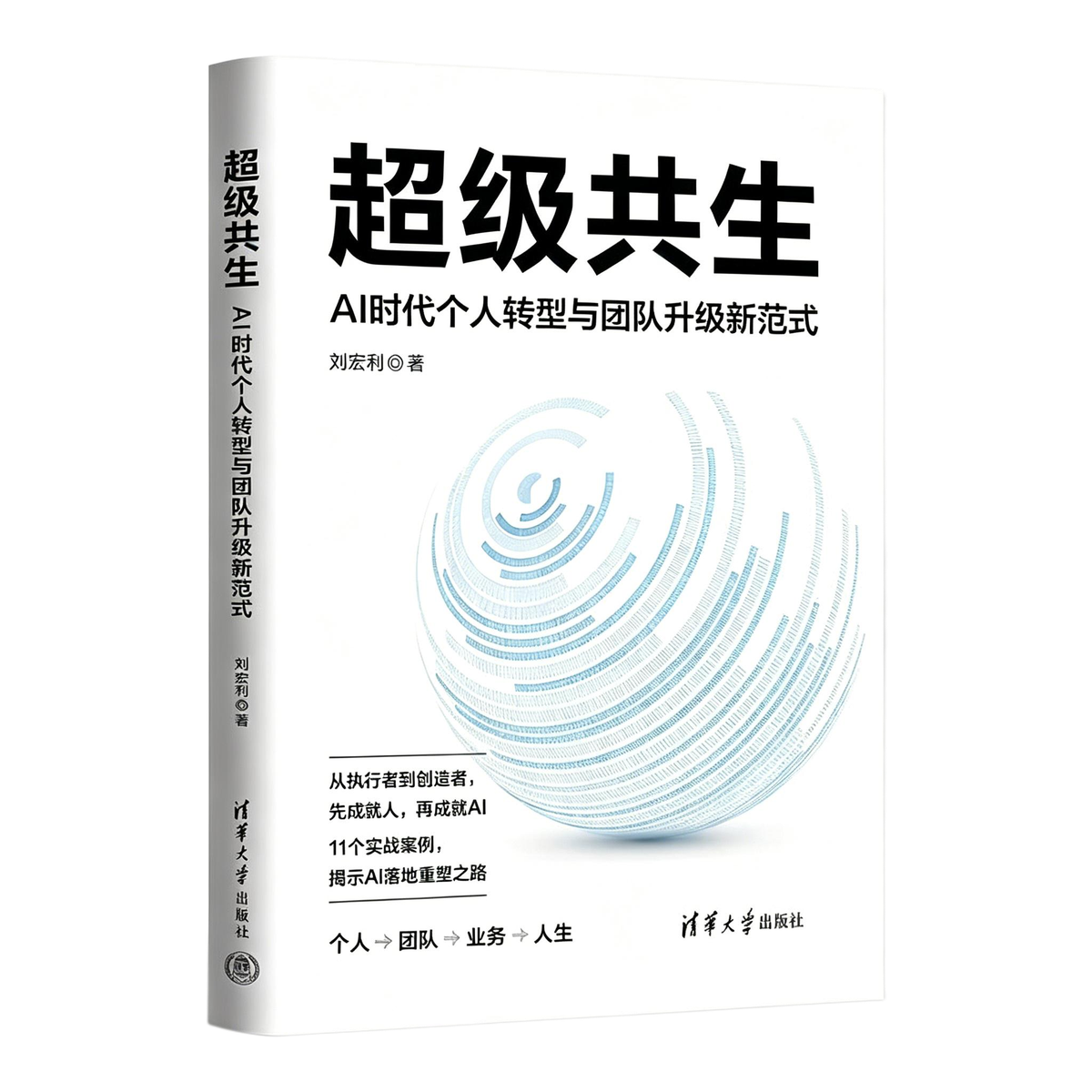
Harmonized Intelligence FAQ
Top questions · By Liu Hongli · Tsinghua University Press, September 2026
What exactly does "harmonized intelligence" mean?
Harmonized intelligence is the core framework of the book. It means humans and AI are no longer in a simple tool-and-user relationship, but are two independent intelligent beings that inspire each other and evolve together. The underlying logic: once AI takes over standardized execution in unlimited volume, people are freed from "getting things done" and move on to defining "what is worth doing". So harmonized intelligence is not about AI doing our work for us — humans handle value judgment and meaning, AI handles execution at scale. Each does what it does best, they strengthen each other, and human creativity gets multiplied.
The book carries this idea through 11 real-world cases. In a car factory, a fitter with ten years of experience saw his polishing skills replicated by an AI robotic arm — he did not lose his job, but shifted his energy to continuous process improvement. A bank risk-control specialist had her document reviews taken over by AI and moved on to refining risk models and mining customer credit value. In the content industry, a veteran entrepreneur saw that the "100,000 Lobsters Plan" would turn the internet into a junkyard with no human voice, and pivoted to a "Million Comments Plan" to salvage real human expression. There is even a "company with no employees": a group of post-2000 artists working as partners, with 50 AI agents handling all standardized work — one person delivered a project worth tens of millions. A cross-border e-commerce team cloned its product-selection logic into AI, building a dedicated digital twin, and both launch speed and results improved. Together these cases show: what makes harmonized intelligence work is never how advanced the tools are, but whether people hold on to the position of defining value.
"This is not merely a division of labor between humans and AI — it is two independent intelligent beings inspiring each other and evolving together. That is harmonized intelligence."
It goes beyond collaboration: humans and AI each do what they do best, strengthen each other, and adapt to each other — humans handle creativity and value judgment, AI handles computing power and execution.
Yes. It unfolds across four levels — individual, team, business, and life — and is the underlying logic of the entire book.
Will AI really replace people?
Whether AI replaces you depends on which curve you put yourself on. If you only do the standardized execution AI can also do, then yes, you will be replaced. But if you take on what AI cannot — understanding the business, reading users, judging where value lies — then AI is not a rival but a lever. The book puts it plainly: AI can replicate "how to do it", but it cannot answer "is it worth doing". What gets eliminated is not "people", but the part of ourselves that stays in execution and treats AI as a competitor.
The book is explicit: AI can replace us in writing copy, building reports, and coding, but it can hardly replace our understanding of a brand, insight into users, or judgment about business direction. It offers two real professionals: a fitter with ten years in a traditional car factory, whose polishing precision was fully replicated by an AI robotic arm — he was not pushed out, but shifted his core value to continuous process improvement; and a bank risk-control specialist of eight years, whose core work of manually reviewing loan documents was taken over by AI — she went deep into risk-model optimization and mining customer credit value. AI did not eliminate them; it freed them from repetitive labor. A cross-border e-commerce team cloned its home-grown product-selection logic into AI so people could focus on decisions, and launch efficiency rose along with results. By contrast, those who treat AI as a competitor, cling to execution, and only ask AI to "do things faster" are the ones trapping themselves in the most replaceable position — the more they use it, the more anxious they get.
"Treating AI as a competitor essentially means trapping ourselves in the execution work AI can replace — and voluntarily giving up our most core, irreplaceable strengths."
The command-and-control function is weakened, but the role evolves into an "enabler of the symbiosis" — and becomes more critical, not less.
Hand your experience to AI to amplify it — move from "executor" to "creator" and become a one-person army.
What do OPT, OVT and DHM stand for?
These are three original concepts in the book, covering the individual, team, and management levels. OPT (One Person Team, the super employee) is an individual who evolves into a business unit driven by "value creation" in the AI age. OVT (One Value Team, the super team) is a team of super employees with mature value judgment who co-create to solve systemic problems no individual could crack alone. DHM (Double Helix Mode) is the management model built for super teams: a "participation helix" that sparks individual intelligence and an "exploration helix" that fuses team intelligence. The three nest into each other, forming a complete upgrade path from individual to organization.
The book grounds all three in real organizations. At a dental chain, customer-service manager Ms. Liu used the STAR-R method to make explicit her decade of "intuitive" judgment about high-intent customers, breaking it into four replicable rules that lifted AI accuracy from under 30% to reliably usable — one person became a whole team, the prototype of OPT. Kimi (Moonshot AI) has no departments or job grades; AI handles standardized management, and a 17-year-old intern joined core R&D and co-authored a top-tier paper — a vivid sample of OVT. ByteDance practices "Context, not Control": OKRs are public to everyone, information is not filtered by hierarchy, and ideas flow freely. And in a "company with no employees", post-2000 artists backed by 50 AI agents deliver projects worth tens of millions single-handedly. Together they show how the three concepts grow from the individual into the organization.
"In the AI age, the individual must evolve into a business unit driven by value creation — what we call the OPT (One Person Team, the super employee)."
The baseline assumption of the AI age has shifted to "unlimited intelligence supply, value first", with individuals driven by "value creation". When AI can complete standardized execution in unlimited volume at lower cost, higher efficiency, and steadier output, pure execution is no longer scarce — an individual's core competitiveness moves from "execution efficiency" to "value creation".
What can an OVT of super employees create that a single OPT cannot? Where exactly does this leap in value show up? In our project practice, OVT value co-creation shows up in three dimensions, as Figure 4-2 shows: systemic problem solving, business value creation, and organizational capability accumulation.
Idea flow needs soil, and it needs direction. Today AI can supply countless data-based "possible answers"; the manager's core duty is to lead the team in defining "the right questions". Management demand in the AI age has shifted from "driving execution efficiency" to "sparking and integrating team intelligence". Building on Pentland's social physics and our years of frontline practice, we distilled the management model for AI-age OVT super teams: DHM, the Double Helix Mode.
How can working people avoid being replaced by AI?
The way to stay irreplaceable is not mastering a tool, but migrating your core value from "execution efficiency" to "value creation". Concretely: organize the business experience, judgment criteria, and decision logic you have built over the years, hand them to AI to be replicated as an executable rule system, and focus yourself on defining value, designing rules, and controlling outcomes. Once AI takes over repetitive execution, you tackle the judgment and creation AI cannot do — and with AI's amplification, you become more irreplaceable, not less.
Two professionals in the book give the answer. The car-factory fitter of ten years saw his polishing precision fully replicated by an AI arm — work that once relied on feel was standardized — yet he was not pushed out; he moved his energy to continuous process improvement. The bank risk-control specialist of eight years had her manual loan reviews taken over by AI and went deep into risk-model optimization and customer credit value. The cross-border e-commerce team went further: they cloned their product-selection logic and VOC analysis standards into AI, built a dedicated digital twin, let AI understand the business while people focus on decisions — and launch efficiency rose with results. After the dental chain's Ms. Liu made her experience explicit, AI first-screen accuracy jumped from under 30%, and her apprentices could follow the same rules. None of them was replaced, because they kept the power to define value — humans define value, build systems, and set rules; AI executes at scale, reliably.
"AI did not eliminate them. It freed them from repetitive execution so they could focus on what is more valuable."
How do I use AI to level up my capabilities?
The key is not treating AI as an efficiency tool, but as a lever and co-creation partner that amplifies your core value. AI is good at standardized execution; humans are good at setting direction and judging value. Combined, your cognitive range, business understanding, and value judgment get multiplied. A practical path: use AI to make your tacit experience explicit — structured interviews that break "gut feel" judgments into replicable rules, then hand them to AI to execute. Your ability settles into an iterating digital twin that gets stronger with use.
Ms. Liu, the dental chain's customer-service manager, is the classic example. Her conversion rate led the team for years, but she could not teach it — her judgment of customer intent was all "feel". After meeting AI, she used STAR-R self-interviews to break a decade of experience into four replicable rules for spotting high-intent customers; AI accuracy went from under 30% to reliably usable, and her apprentices could follow along. The content-industry entrepreneur used AI to war-game the endgame of the "100,000 Lobsters Plan", saw the content internet sliding into dead silence, and pivoted to the "Million Comments Plan" to protect real human voices. The cross-border e-commerce team cloned its selection logic and VOC standards into AI and built a dedicated digital twin — AI understands the business, people focus on decisions, and launch efficiency rose with results. AI did not think for them; it helped them see, dissect, and amplify the abilities hidden in their heads, settling them into an iterating digital twin. As the book says: the same AI tools deliver completely different value in different hands.
"What AI amplifies is the core value we already have — our cognitive range, business understanding, and value judgment. We ourselves decide how much this lever can do."
What exactly is Taste — the power of value judgment?
Taste (value judgment) is the individual's irreplaceable core competitiveness in the AI age: the human-centered ability to tell, among countless possibilities, what has unique value, what adds incremental value, and what creates long-term value. It matters because when execution can be supplied by AI without limit, "doing it fast" is no longer scarce — "choosing right" is. Taste is the core of the "value creation" growth logic and the basis for a person to leap from execution cog to business unit. It breaks into three mutually supporting sub-abilities: professional connoisseurship, essential insight, and direction choice.
The book explains Taste through contrasting cases. McKinsey scaled its AI agents from 3,000 to about 20,000, and consultants shifted from selling billable hours to binding themselves to clients' long-term results — powered by judging "what is worth doing". Meanwhile nearly 30,000 Oracle engineers fluent in AI were laid off, because their value stayed in execution and never migrated up to judgment. The content entrepreneur hit the brakes while the industry sprinted into the "100,000 Lobsters Plan", halted fundraising, and built the "Million Comments Plan" to salvage real human voices — his value yardstick told him that before AI content drowns the internet, authentic expression is the scarcest unique value. The e-commerce team using AI to understand the business rather than just crunch data, and Ms. Liu making her intent-judgment explicit, are all Taste at work. The book splits Taste into professional connoisseurship, essential insight, and direction choice; the gap between winners and the rest lies exactly in insight and direction — the judgment to hold the line inside a hype cycle and recognize unique value.
"Value judgment (Taste) is the core of the value-creation growth logic — the irreplaceable core competitiveness of the OPT super employee in the AI age."
What does the manager's role become in the AI age?
The role shifts from "controlling execution" to "sparking and integrating team intelligence". In the industrial age the manager was the hierarchy's "information router" and process supervisor; in the AI age, information syncs in seconds and execution is supplied without limit, so that function is hollowed out. The new core duties are defining the right questions, shaping a field of equal interaction, and letting every member's value judgment collide in the idea flow. In short, the manager is no longer a progress-watching overseer but the enabler of the symbiosis, turning human intelligence into real value.
The book grounds the shift in real organizations. In 2026 Deloitte scrapped the decades-old "analyst–consultant–manager" pyramid, because AI agents had hollowed out the bottom and were eating into the middle and upper layers. Block cut headcount from over 10,000 to under 6,000, replacing middle-layer information relay and coordination with AI — the stock surged, and the goal is to double gross profit per person. ByteDance has practiced "Context, not Control" for a decade: OKRs public to all, information unfiltered by hierarchy, employees free to bring sharp opinions straight to the CEO, so the front line judges from context instead of waiting for orders. The book also cites Pentland's social physics: team intelligence depends on the quality of idea flow, not average IQ — the manager's new duty is to spark everyone's Taste. The most extreme sample is the "company with no employees": post-2000 artists as partners, 50 AI agents handling standardized work, the manager's role gone — what remains is a coordinator of value co-creation.
"Management demand in the AI age has shifted from 'driving execution efficiency' to 'sparking and integrating team intelligence'."
So what is an OVT super team?
OVT (One Value Team) is the book's new team form for the AI age: a team of OPT super employees with mature value judgment, co-creating to solve core problems no single individual could crack. The fundamental difference from industrial-age teams: old teams used division of labor to boost execution efficiency; OVT uses complementary strengths to create shared value. The team's value is defined by the market and users; its reason to exist is co-creation, not control. Everyone is a value creator playing to their strongest suit.
The book offers vivid samples. Kimi (Moonshot AI) has no departments, no job grades, no OKRs — you just go find whoever you need, AI handles standardized management, and a 17-year-old intern joined core R&D and co-authored a top-tier paper. Flomo has only two founders; instead of efficiency or generation features, it focuses AI on "related notes" and "AI insights" to help users think — in five years it has recorded over 100 million notes and swept industry awards. More extreme is the "company with no employees": post-2000 artists as partners, 50 AI agents behind them, one person delivering a project worth tens of millions, with capabilities settling into reusable digital assets. The book adds that in the Open Claw ("crayfish") craze, the ones who actually grew into OVTs were not those with the fanciest tools, but teams that treated AI as a co-creation partner and used complementary strengths to solve systemic problems. Together they show: OVT value comes from co-creation built on complementary strengths.
"In the AI age, the core meaning of a team upgrades to 'co-creation — a symbiotic network'. In practice we call this new team the OVT (One Value Team, the super team)."
How should a small team organize around AI?
Flip the logic: don't create posts first and then fill them. First lock onto the key business problem, define the value to deliver, then break down the core capabilities needed and match the right OPTs to form a value community. In other words, the team starts from "what business problem are we solving" and ends at "did we deliver value". AI takes on standardized execution and information sync; people focus on judgment and creation — so even a tiny team keeps independent competitiveness and keeps accumulating capability.
Two tiny teams in the book are the template. Flomo has just two co-founders, takes no funding and sells no ads; it uses AI for "related notes" and "AI insights" to help users think rather than write for them — five years, over 100 million real notes, and every major industry award. The "company with no employees" goes further: post-2000 artists gathered as partners, 50 AI agents handling information summaries, progress tracking, and content generation, compressing 18 months of development into three; one person's experience settles into reusable workflows stored in the organization's digital asset library for the next person to call up. The cross-border e-commerce team is another example: they cloned their selection logic into AI and built a dedicated digital twin, and the small team keeps launching products and delivering results. The book stresses that OVT building starts from defining the business problem and the value to deliver, then matching capabilities — letting tiny teams build their "permanent camp" on digital assets.
"A team's core value is no longer breaking tasks apart for execution, but integrating strengths to achieve 1+1>2 value co-creation."
Why do most enterprise AI transformations fail?
The root cause is usually using "deterministic logic" to steer AI, which is a "probability space". Industrial-age business runs on decomposition, standardization, and control, so companies habitually bolt AI onto old scenarios, or treat AI as a mere efficiency tool — keeping all the efficiency gains while pushing the risk down to employees. The result is four collisions: scenario mismatch, rule immunity, misaligned incentives, and missing management. Even more common is the collective anxiety of "install a tool and you've kept up", chasing tools without building capability — and making things messier with every change.
The book points out two classic failure modes. After the 2026 Spring Festival, Open Claw (the "crayfish") swept through workplaces; everyone feared "falling behind without a lobster", equated tool mastery with competitiveness, and slid into collective frenzy with no one asking "where does this road end". The deeper problem is cognitive mismatch: many companies merely stack AI features on old business; processes naturally reject AI's uncertain outputs, so AI gets marginalized. Employees are told to hand over their experience to train AI while facing the risk of "teaching the apprentice to replace the master" — the rational choice is not to cooperate. The preface's dental-clinic story reveals the full chain of four collisions from individual to organization: scenario mismatch, rule immunity, misaligned incentives, missing management. Many firms keep AI's efficiency gains for themselves and push the risk to employees, meet resistance, and end up "tool installed, standing still". The book concludes: steering the "probability space" with "deterministic logic" is the root of failed enterprise AI adoption.
"Steering a 'probability space' with 'deterministic logic' is the root cause of most failed enterprise AI adoption."
How should a company govern its AI applications (AI governance)?
AI governance is not cold water on innovation — it is setting defenses in advance along three boundaries: technology, responsibility, and humanity. Technologically, "govern up front rather than patch afterward": embed safety assessment across the AI lifecycle. On responsibility, "be explicit rather than vague": dedicated governance roles and cross-functional coordination. On humanity, "human-led rather than tech-run-wild": final decision power at key points stays with people. Effective governance is government, business, and society working in concert so technology delivers steadily inside a controllable frame — not restricting technology itself.
The book uses real risks to show why governance matters. In 2025 two AI companion apps leaked data of over 400,000 users through security holes, exposing more than 43 million private conversations. McKinsey's 2026 trust survey found nearly two-thirds of companies rank security and risk as the top obstacle to scaling agents, yet actual mitigation clearly lags. The auto-parts company in the book offers the positive sample: instead of rushing to launch, it first broke expert experience into traceable, reusable Skill modules; AI only calls mature modules, every operation leaves a trace, and final decisions stay with the business owner. The book also notes Workday being sued by job seekers over alleged algorithmic discrimination in AI hiring, and Waymo's autonomous-driving accidents raising liability disputes — reminders that once AI enters real business, humans must hold the responsibility line. Hence the three boundaries: up-front governance, explicit responsibility, human leadership — so AI can take root reliably on the industrial floor.
"When AI moves from concept carnival to the industrial floor, the real test is not how dazzling it is, but how reliable it is."
How do you actually evaluate AI's performance?
Don't just count "how many execution tasks it did". Look at what real business value it created, what real problems it solved, and how people and the organization grew because of it. In the AI age every OPT is an independent value-creation unit, and incentives shift from "paying for results" to "investing in growth" — growing AI capability and Taste together. So evaluation should land on value delivered, capability maturity, and inner growth — not hours, task counts, or bare efficiency numbers.
Pang Donglai is the book's model of "investing in growth". It doesn't drive execution with KPIs; since 2000 it has shared profit by role — in 2025 its 8,000-plus employees averaged about ¥9,000 a month, with per-capita distributions up to ¥100,000. The same year it launched a "school-style" program tying income to culture level, skill level, and creativity, with 7-hour workdays and 40 days of annual leave; over 97% of employees are satisfied with their time off. Trusted and respected, employees repay it with efficiency and reputation far beyond the industry. For method, the book's "nine-grid growth map" sorts people into red, yellow, and green zones by Taste and AI capability, with matching incentives — "find your footing", "fix the gap", "amplify value" — binding personal growth to organizational value. It stresses that AI-age incentives move from paying for results to investing in growth; judging only task volume and efficiency numbers forces people to treat AI as an efficiency tool and slide back into execution. Pang Donglai proves: invest in people, and people repay with value.
"Under the baseline assumption of 'unlimited intelligence supply, value first', the OVT super team runs on co-creation, and every OPT super employee is an independent value-creation unit."
What does "AI for good" actually mean?
At its core, "AI for good" means holding the humanistic boundary of "human-led, not tech-run-wild". The book stresses that human-AI symbiosis ultimately lands on the human: AI is tool and partner, not replacement or master. Doing good is not resisting technology — it is keeping technology in service of human value: in decisions that touch individual rights, business operations, and social functioning, final responsibility must rest with people; and technology must not erode human thinking, emotional bonds, or self-identity. The symbiosis should revolve around "making people better people".
The most moving story in the book is "the dragon-slaying youth who almost became the dragon". Dr. Zhang, founder of Aiden Dental, quit a secure public-hospital director post to "treat teeth honestly and cheat no one", but was swept up by capital and traffic — pushing implant subsidy schemes and conversion quotas — until he saw colleagues' eyes reduced to sales numbers. One night he dug out patients' thank-you letters and wept at his exhausted reflection. The book also cites a Stanford survey: people fear AI weakening independent thinking and real emotional connection. Through Dr. Zhang's dilemma the book makes the point: when technology rushes at us, holding the human line matters far more than chasing efficiency. Story and data together say: the root of AI for good is people keeping their original intent and goodwill, refusing to be warped by tech and traffic — so every use of technology points toward "making people better people".
"The heart of human-AI harmonized intelligence is the human. AI is humanity's tool and partner — not its replacement or master."
A hundred-year life is long — how do I find my place in it?
Settling yourself in a hundred-year life means walking from the industrial-age "life track" into the AI-age "open field": no longer seeking security on the fixed path of study–work–promotion–retirement, but polishing your own "beautiful work" at the intersection of what you love, what you're good at, and what creates value. AI has torn down the technical, resource, and team barriers to creating — one person plus AI can be a whole army. The key is taking back agency: let love fuel the drive, strengths build the long board, and value anchor the direction.
Two stories in the book form a sharp contrast. A 13-year-old girl independently built an English-tutor agent and an emotional-support agent in her spare time, iterating over 300 times on her own needs; her work was featured at a Doubao launch event and won a public-service award — she was already living by creator logic. An old friend was once a director with light in his eyes; a decade of being dragged along commercial tracks locked his director's dream into a drawer, and the director's chair sat empty for ten years — yet AI-age tools offer him exactly the path to re-materialize a creative methodology built over a decade and turn the work real again. The book also recalls the content entrepreneur who halted the "100,000 Lobsters Plan" for the "Million Comments Plan" — re-choosing, on the scale of a hundred-year life, what he truly wanted to do. They confirm: in the open field, AI is a traveling companion; humans set direction and give meaning, turning the flame inside into light for the world. With the compounding of goodwill, the book shows how to keep your own hands on the wheel of a long life.
"In the AI age we will finally shake off the standardized track and walk into the creator's open field — a truly super life."
Browse the Book's Q&A by Chapter
Each chapter distills its core questions, answered in the book's own words:
Chapter 1 Chapter 2 Chapter 3 Chapter 4 Chapter 5 Chapter 6 Chapter 7 Chapter 8 Chapter 9 Chapter 10 Chapter 11